How the “Amish awakening” is applying a small-church discipleship model
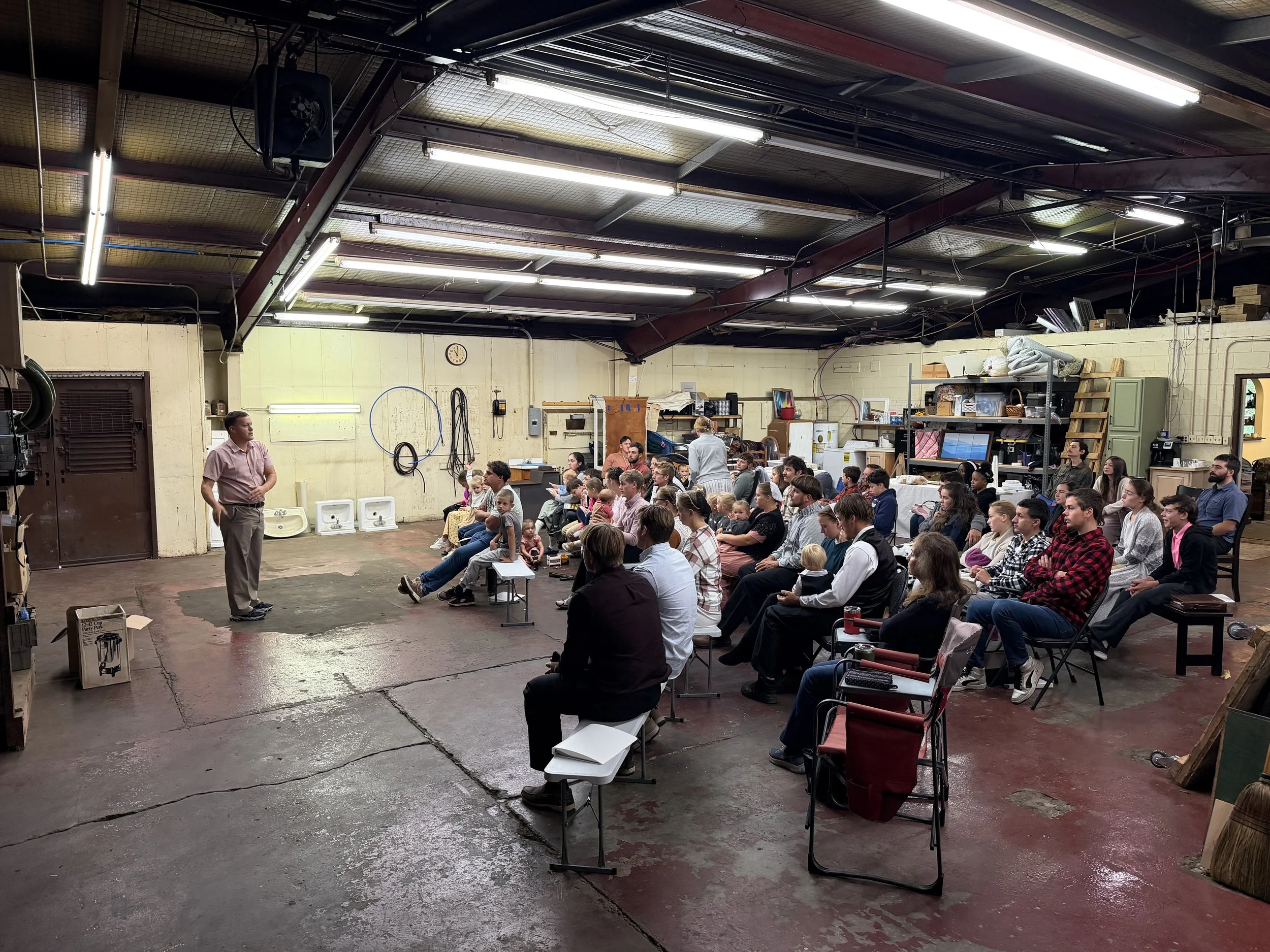
Jonas Kurtz teaching at a house church of Amish-background believers in Nicktown, Pennsylvania. This meeting looks more like a “shop church” as the hosts did not have a large enough room in their house.
Last year, I described how my friends David Kirkwood and Jonas Kurtz were supporting spiritual revival among the Amish in North America—a group known for its simple living, communal lifestyle, and tendency toward legalism and works-righteousness.
A few weeks ago, I featured efforts to apply the model known as Disciple Making Movements (DMM) to revitalize evangelism and discipleship in the US context.
In today’s post, those two topics come together, because the Amish awakening leaders have found that DMM is a good fit for people of Amish background.
I asked Kurtz to update us on how things are going and what he has learned.
Q&A with Jonas Kurtz
What is the status of your congregation of formerly Amish people?
We have formed a house church at which 80 percent of the regular participants come from an Amish background. We have no ordained pastors or elders, but I am looked to as the unofficial leader, probably largely because I was ordained into the Amish ministry. David Kirkwood also attends this church and teaches on some Sundays.
We originally gathered as a number of small groups every week, following DMM principles. In the past year, we began to desire a more corporate meeting, and we also found that those with the gift of teaching were not getting much opportunity to use it in a small group setting. Furthermore, those who learn more by hearing than by participating were not getting enough opportunity to grow. So now we meet as a larger house church every other week, and then in small groups in the other week.
Our goal is to combine the best features of the DMM world—personal interaction, mutual learning, and accountability—with the benefits of the prevailing model, including corporate worship and teaching from those who are gifted in that area. Meeting every two weeks fits in well with those from an Amish background, since that is what we were used to when we were Amish.
When we meet as a large group, we retain some things from our Amish experience. The Amish always have a short sermon followed by a longer one. After worship, we share a meal and spend a few hours fellowshipping. Though we have 30 children under age 10, we don’t have a Sunday-school program, preferring to have them sit with their parents. We do not need any financial resources, so we don’t take up an offering. When someone in our group has a practical need, we announce that an offering will be taken and then usually give the money directly to that person.
We are also connected to other house church movements. Once every three months, we gather as a regional house church network in New York or Pennsylvania, to fellowship and to share the gospel with others.
What aspects of your Amish training remain valid and valuable to you, and what has changed in your thinking?
The primary part of my Amish upbringing that remains valid to me is the community aspect. One main reason why we have remained a house church is that we want to maintain a close-knit community as much as possible.
What patterns, either positive or negative, do you see in the spiritual development of former Amish believers?
One good pattern conducive to their development is their desire to help others in any physical way possible. Many Amish are currently involved in US disaster relief efforts; in fact, the Amish have an ongoing, organized effort to support rebuilding in North Carolina following Hurricane Helene in 2024. They continuously have a busload of Amish folks working there, rotating new workers every two weeks. My father, who works for Mennonite Disaster Services, has spent much of the summer organizing cleanup and relief efforts after a large fire in Colorado. Other families are involved in Latin American mission or in adopting children with disabilities.
Amish-background believers understand that believing in Jesus often comes at a large social cost. As a result, they are much more likely to count the cost and make a genuine commitment to Jesus than people in the non-Amish world.
In contrast, one area that is detrimental to spiritual growth is their inability to resolve conflict. It is normal in the Amish world, when conflict arises in a church, for people to move to other areas or new communities rather than resolving the problem. This is due in large part to the fact that leaders are often unyielding, not willing to listen to other opinions, and unable to admit when they have been wrong.
This can remain a challenge after people leave the Amish. When a disagreement occurs, these people have weak conflict resolution skills, so it will often escalate and result in people parting ways. Some former Amish seem unable to stay in any church for very long before something comes up that they don’t like, and off they go to the next church.
Those who have newly left the Amish are often vulnerable to new winds of doctrine. Some YouTube preacher with charisma can influence them heavily, and they are unable to discern truth from untruth, at least initially.
You note the tendency among Amish people to feel spiritually superior. Does that carry over into believers’ new lives? How can you instill a sense of humility in people who formerly felt convinced of or even proud of their holiness?
Thankfully, in many cases this problem does not carry over into the life of a new believer. I find it most frequently among people who have been born again but still try to remain faithful to their Anabaptist roots. They can develop the attitude that they are spiritually superior because they “literally” obey the words of Jesus.
I try to counteract this by teaching that there are things the Bible is silent about and that we will naturally have differing convictions on some matters. Sadly, however, some of these individuals can be just as difficult to work with as Amish people who have not yet been born again.
What lessons have you learned from your experience that you believe are applicable to other cultural situations?
I have learned that it is difficult to reach someone if they feel you are disrespecting the culture or group they are currently part of. Of course, when you speak the truth, some people will take offense. But if my goal is to win an argument, my success may come at the expense of building a relationship that could eventually lead someone to be born again.
My most fruitful interactions with Amish people who are not yet born again are those in which I ask questions rather than simply making statements. Almost all the Amish people I have seen come to the Lord over the past four years did so because they had a question for which they had no answer, which led them to turn to the Bible and seek answers for themselves. I try to ask questions that are relevant to their culture, such as “What is the biblical foundation for excommunicating those who leave you?” The most strategic approach to reaching people of other cultures is to pose carefully constructed and sincerely intended questions.