More insights on giving to the Majority World
Reader responses provide considerable food for thought
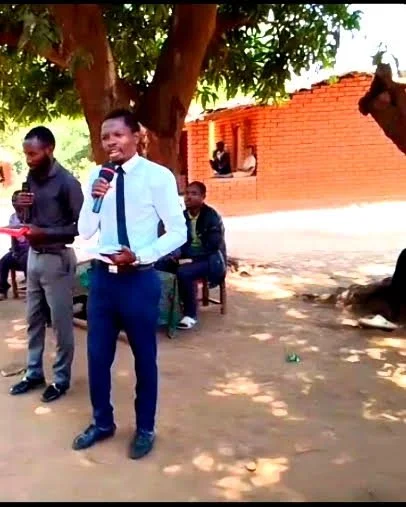
Dalitso Mpanje (right), founder and superintendent of the Wesleyan Nazarene Church of Malawi, speaking at a youth camp meeting.
My March 27 post, “How much money should the West send to the Majority World?” generated some extremely insightful responses, all of which are worth reading. I asked several respondents to expand on their comments for this post.
Dalitso Mpanje is founder of the Wesleyan Nazarene Church of Malawi, a young denomination with 15 congregations in Malawi and Zambia. He has firsthand experience in dealing with cases of alleged misuse of donated funds. His comments follow.
Supporting fellow Christians in need is an important biblical priority, as shown by Matthew 25:35–40, Galatians 6:2, and Acts 2:44-45. However, it is necessary for Minority World Christians to consider certain procedures when they want to help a Majority World ministry.
I have observed that some pastors are not honest when it comes to issues of money. They are cheating their churches or ministries and do not disclose the funds they are receiving. So I would recommend that people wanting to send funds to Majority World ministry adopt the following steps:
Before everything else comes prayer.
Build a good partnership with a church or ministry, based on mutual trust, shared purpose, humility, and open communication.
Make sure that the church or ministry is operating properly. Ask for legal registration documents or evidence of the leader’s credentials. If you cannot visit the location personally, try to find someone who has tangible information about the church or ministry.
Understand the church or ministry’s context and its members. This could be done by participating in services and meetings through virtual media platforms such as Zoom and WhatsApp. For example, I invited Bruce Barron to attend one of our pastor trainings and speak to the pastors.
Ask the church or ministerial leadership to explain how they get their funds and how the money is used. Ask them to share any reports they have produced, along with pictures to reflect the use of the funds.
Confirm that the funds will be used for church or ministry purposes, not personal items. For example, Bruce sent me money this year for two specific purposes: purchasing a speaker system for ministry and registration with the Evangelical Association of Malawi. I send him updates as part of our mentoring relationship.
In summary, effective support lies in building good partnership, honesty, mutual trust and commitment, understanding shared purposes, humility on both sides, and encouraging each other through open communication. I encourage you to support God’s work through the servants he has chosen to work on his behalf. Invest your resources in churches or ministries rather than in secular things, and God shall reward you.
Jim Harries has lived in Kenya since 1993 as a missionary who has sought to become fully embedded in the local culture. He is founder of the Alliance for Vulnerable Mission, whose current director, Marcus Grohmann, I interviewed for this blog last April. Donations can be made through this link. His comments follow.
Facilitating “Honesty” in Africa
I have put “honesty” in quotation marks for a reason. “I’ll be back in a second” is dishonest in a literal sense. The phrase is widely used by native English speakers, even if a minute or more is in mind! My reference to honesty is not to the literal use of language, but to the use of language that follows “normal” conventions.
Many conventions of language use that are normal in the parts of Africa where I have worked would come across as ‘dishonest’ to Westerners. For example, people do not keep time in a Western way. What in the West would sound like promises made to do something at a certain time are routinely broken.
So, when I talk about “honesty” in Africa, I mean speaking in a way that is normal in Africans’ own communities, as opposed to changing what they say and how they say it with the purpose of attracting donor funds.
An African colleague working for an international organization recently referred to the idea of “donor-speak.” This term describes a way of communicating that an African person’s usual African interlocutors would find dishonest. It is a presentation of truth intended to facilitate or perpetuate donor funds. Perhaps it is widely used in many poor parts of the world.
At least two challenges confront a potential foreign donor:
1. To understand what is being said by an African person requires comprehending conventions of how members of their community normally communicate. Such conventions may be very different from conventions widely upheld in the West. Included is having a grasp of how English terms and phrases are chosen to translate terms in the indigenous African languages in use in people’s community.
2. To ascertain when “donor-speak” is being used for one’s benefit.
I will explain one aspect of this dynamic. People in African communities known to me have much fear of envy. This is because envy is the basis for witchcraft, and witchcraft is widely understood as bringing many problems and even blamed for killing people.
Discussion that provokes envy can be avoided at all costs. If one is asked “what is your business worth?” the response may be “$50,” even if it’s actually worth several thousand dollars. If you ask someone how many cows he has, then if you are the girl he wants to marry he may say he has 20, but if you are the father who wants generous bridewealth, his opening gambit may be “I only have a few goats.”
Robert Osburn is senior fellow at the Wilberforce International Institute and has dealt extensively with corruption issues in the Majority World. He is busy finishing a book, so I’m reprinting his comment on the March 27 post below.
I appreciate your approach, Bruce, and mirror it to some degree in my own giving practices. But I think we have to consider some other supplementary practices, including explicitly teaching how wealth is created (by developing products and services that serve my neighbors’ needs so that in turn my neighbors can show love to me by paying me for those products and services) and how some culturally developed attitudes can undermine wealth creation (such as the extensive practice of demand-giving).
We need to also openly teach about how many people want their children to live in the West so that those children can send home foreign remittances, thus tragically reinforcing the brain drain that enhances the failure to create wealth. We will have to be honest with ourselves that families who receive foreign remittances are less inclined to vote and pressure their governments to act with integrity and justice so that people are incentivized to be wealth creators. We will also have to be honest about how a primary way to super-charge wealth creation is through defendable (and legally defended) land titles, which are non-existent for huge numbers of people in these countries. We will also have to talk openly about how widespread corruption, along with state institutions that make it very hard to legally create businesses, undermine the incentives for wealth creation.
More inspiration from Gatore Herve in Uganda
My March 27 post began by telling the story of Gatore Herve, who pastors a church in a southwestern Uganda refugee camp. I did not realize that Global Trust Partners has published Gatore’s story in inspiring detail, including how he has taught his congregation to live out Christ’s call to generosity. I encourage you to read it.