Some of the most glaring discrimination in the church …
… is against unmarried people. Here’s a better vision for singles.
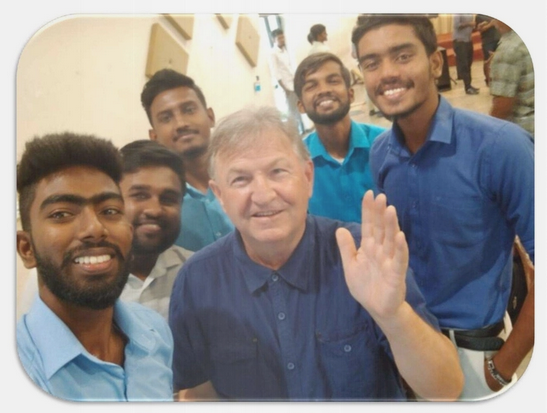
Mark McLeod, international advocate for Christian singles, with a group of colleagues in Sri Lanka.
To me, one of the most bizarre tendencies in the body of Christ is the devaluation of singleness. Both Jesus (Matthew 19:12) and Paul (1 Corinthians 7:8, 32–35) seem to treat being unmarried as an honorable or even desirable state. Celibacy was greatly respected in the early church; the Catholic Church’s expectations for priests carry that tradition forward today. But many in the body of Christ view singleness among people of marrying age as a misfortune to be avoided at all costs. Singles are often marginalized in church social life and ministry life, or they are relegated to separate “singles groups,” a main purpose of which is often to help Christians find partners.
Mark McLeod sees things differently. As head of the World Evangelical Alliance’s (WEA) singles initiative, he seeks to help the church create spaces that value, engage, and empower this growing community. (And the single or single-again population is mushrooming thanks to young people delaying marriage in many cultures, high divorce rates, and older people outliving their spouses.) McLeod has found especially productive ministry fields in Asia. He recently spent several months in the Philippines assisting the newly formed Singles Commission of the Philippine Council of Evangelical Churches.
When I posted on marriage several months ago, I promised a future blog post on singleness, but I had to wait for McLeod to find the free time to answer my questions! I hope you will find this interview worth waiting for.
How did you get into singles ministry? How and why has it been a fulfilling calling for you?
I am a member of a large evangelical church in Canada. As a tenor in the choir, I remember leaving choir practice late on Thursday evenings and seeing shadowy people leaving Room 129, the singles meeting room. I wanted no part of that stigmatized world, even though as a single-again person I had lived in it for many years.
Because of the sensible ministry of our singles pastor, I found the courage to embrace my stigmatized world. What I found in Room 129 was single and single-again doctors, lawyers, truck drivers and entrepreneurs … beautiful, handsome, successful people. On the other hand, quite a few of those in the singles group were bitter, broken, hurting, lonely and sometimes angry.
Having been connected to the WEA for many years, I shared my pastor’s book on singleness with WEA leadership, with the goal in mind of addressing what we now recognize as a massive and growing evangelical singles demographic. Of the 700 million evangelicals worldwide, perhaps one-third may be single persons.
For the past several years, my pastor and I, along with a growing network of singles influencers, have been advancing a series of initiatives. I am not sure this is a calling; rather, it is more of an obvious practical response to an incredibly complex world that I and millions of others happen to orbit. Having been happily married for 20 years and single for the last 27, I think I can find fulfillment cheerfully spinning around either world.
Why do singles need a separate ministry?
In a wider and perhaps more strategic sense, the Christian world needs not only obvious and strategic forms of singles ministry but a foundational biblical theology of singleness, coupled with intentional singles advocacy from which ministry can then form. Apart from scattered church singles ministries here and there, the church has never intentionally advanced either of these foundations. But in the last half-century, many societies have reached the point where married people are a minority among adults.
Tell us what you think all Christians should know about single and single-again members of the body of Christ and how the rest of us should engage with them.
The guiding principle of the WEA Singles Initiative recognizes that every human is spiritually and naturally a unique and eternal imager of God. Nevertheless, singleness, except perhaps for young adult singleness, has historically been stigmatized.
I was shocked by one comment from a South Asian evangelical leader at the WEA’s 2019 General Assembly: “Mark, in my country, even in the church, singles are considered cursed.” I heard similar sentiments from several African leaders. Occasionally, my queries about singles in the church brought surprisingly hostile replies such as “If a man is unmarried, there is something sexually wrong with him.”
Through awareness, acceptance, and advocacy, we seek to challenge the stigma of singleness and replace it with a paradigm that fully values, engages and empowers single persons.
Describe what you’ve been doing over the last few years and the fruit you’ve seen.
Our vision encompasses four main activities: an influencers network, advocacy teams, a social media presence, and producing publications. We helped the Philippines establish a Singles Commission, and evangelical alliances in India and Nepal intend to form similar commissions this year.
To me, it’s fairly obvious that singleness is not just an honorable status, but even beneficial for some ministry roles. Do you have trouble getting people to understand this? If so, why, and how are you combating the problem?
Singleness is an incredibly complex and often stigmatized issue across human society at large, and the church mirrors that societal stance more often than not. We want to change the paradigm to one where the church holds a higher view of singles. Almost without exception, the leaders with whom we have had dialogue are positively embracing the WEA Singles Initiative. It is, as Spock would say, logical.
What happens to someone who is prominent in singles ministry if that person gets married? Does the person’s work with singles end at that point, or how can it continue?
One of the healthy things my church’s singles group expected was that if a leader in the singles group got married, that person and the new spouse would remain in leadership for a season. This allowed for a healthy transition and also offered encouragement and hope to others in the group who desired to marry. The WEA Singles Initiative, in fact, has several married couples among its current group of influencers.