What it’s like to bring Christ into Nicaragua
A visiting educator reminds us not to bring secret messages in our Bibles
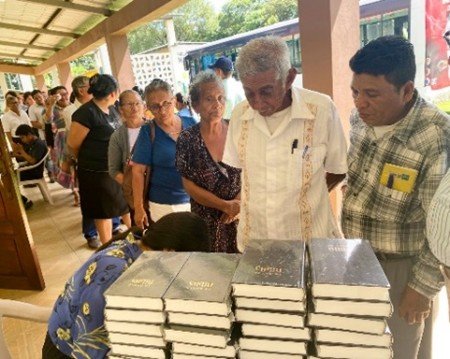
These Bibles made it across the border to an event in Nicaragua.
Nicaragua rivals Cuba and Venezuela for the unhappy title of most oppressive state in the Western Hemisphere, and some fear that Honduras could be moving in the wrong direction on issues of human rights and religious freedom. On November 3–10, Richard Smith, director of the Kuyper Christian Study Center in Buenos Aires, Argentina, and his colleague Iván Tomassini, academic coordinator of the center, visited those two countries. I invited Richard to share a summary of the trip, which illuminates the needs and ministry opportunities there.
We started in Honduras, where we met with evangelical university students, talking about calling and the biblical worldview. Sadly, they lacked understanding about the biblical story. In fact, it was difficult to engage them in discussion, as they are not accustomed to group reflection about their faith. They did not even recognize the word “worldview.” Later that day, at a different university with a mix of Christian and non-Christian students, the interaction was livelier. We presented the gospel through the lens of calling and worldview.
The next day, we traveled six hours to Nicaragua and spent an additional three hours at the border. The officials’ suspicion was palpable, for our Honduran host had brought several boxes of Bibles to distribute. The officials confiscated a Bible to see if secret messages were hidden inside it. (One officer said he wanted a copy. Lord willing, he will actually read it!)
The night before the Bibles were distributed at the church where we were speaking, a policeman pulled our host’s car over and noticed the boxes full of Bibles. He detained us for an hour, trying to intimidate our host and secure a bribe.
At the airport, a sign declares that “journals, magazines and Bibles” may not be brought into the country. But as the photo above shows, the Bibles reached their destination.
Despite the delay at the border, a large group of teachers and parents waited for us at a Christian primary school. I spoke about the pedagogy of ancient Israel and Iván spoke about the renovation of our minds as described in Romans 12:1–2. The school’s director remarked afterwards, “Your presentations left me thinking. We decided that in the following year and for the whole year we will teach the Ten Commandments to the children as a biblical foundation.”
November 7 was a busy day. In the morning, we spoke about the biblical worldview. In the afternoon, we met with pastors to present our Kuyper Christian Studies Center as a model for ministry. This generated a lot of discussion. Providentially, a resident Dutch missionary shared about the great impact of our namesake, Abraham Kuyper, for they did not know who he was. That evening we spoke at a former Pentecostal church that is now Reformed. They were very attentive and inquisitive.
On the 8th, we spoke at a conference attended by 114 people, including more than 20 pastors and leaders from Reformed, Baptist, and Pentecostal churches. I spoke about biblical anthropology and Iván about common grace. We had been warned to avoid using political terms such as government, democracy, human rights, justice, and so on (which is a bit challenging when one is teaching about the cultural mandate and the image of God). Local leaders told us to assume that government spies were in attendance.
We finished our time in Nicaragua by preaching in different churches on Sunday, November 9.
It is impossible to ship books to Nicaragua, but we were able to carry in several texts to an aspiring Christian library and study center.
At every event, we observed an inspiring hunger to learn. Though the country is very poor and lacks many resources―many of the churches lack decent bathrooms, for instance―they possess the disposition, essential for true followers of Christ of readiness to learn. Like Mary of Bethany, they are eager to sit at Jesus’ feet. Let us pray for these longsuffering Christians and their ministries.