Christianity is not a power tool
Jeff Fountain’s diagnosis of the un-Christian nature of “Christian nationalism” is the best one I’ve read
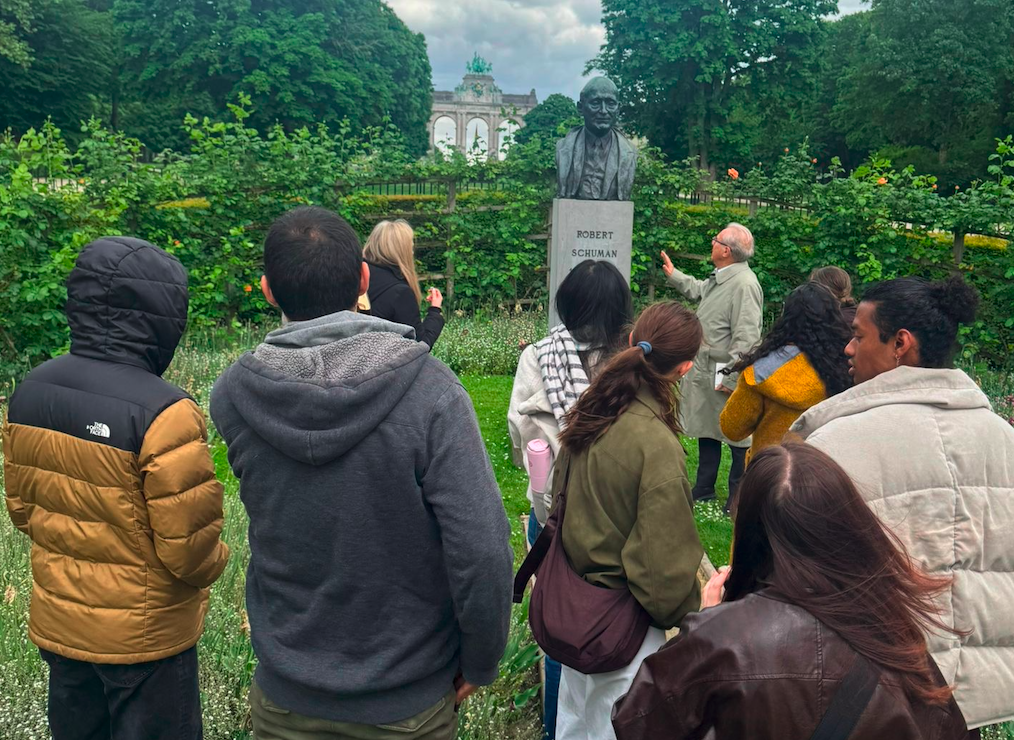
Jeff Fountain teaching students alongside a memorial to European Union founder Robert Schuman in Brussels, Belgium.
Jeff Fountain is one of the deepest Christian thinkers I know on issues of cultural engagement. After serving as European director of Youth with a Mission for 20 years, Fountain founded the Schuman Centre for European Studies in 2010. The center (named for French Christian statesman Robert Schuman, a key contributor to the creation of the European Union) examines issues in Europe from a biblical perspective.
Fountain posts a “Weekly Word” message every Saturday. On May 23, he addressed the attractiveness of “Christian nationalist” worldviews in a masterful 800-word essay.
To me, all modern forms of Christian nationalism are deeply flawed on a theological and missional level, because they substitute grievance for servanthood and seek to dominate rather than living out the Golden Rule toward our non-Christian neighbors. I’ve been saying these things for 30 years, but Fountain says them much better than I do. I believe his essay, reprinted below, deserves to be widely read. It should be treasured as a teaching tool long after the contemporary leaders he cites are gone.
I would welcome contributions to this discourse from Christians who are affected minority groups rather than drivers of nationalist movements, such as in India, Nepal, or the Middle East.
Christianity: A power tool?!
by Jeff Fountain
A seductive narrative has captured parts of the conservative Christian world: that we need strong nationalist leaders to defend “Christian civilization” against secular liberalism, moral decline and cultural fragmentation.
In this story, Putin is cast as the guardian of traditional Orthodoxy, while Trump is portrayed as the defender of Christian America. Viktor Orban reinforced the same theme during his autocratic rule in Hungary: Christianity fused with nationalism and civilizational struggle.
Yet this rhetoric profoundly distorts the Christian faith. In both Putin’s Russia and Trump-era American nationalism, Christianity is increasingly reshaped into a political religion of grievance, power and militarism—selectively invoking biblical imagery while ignoring the core biblical command to love one’s neighbor.
Most disturbingly, this movement glorifies war and violence. The Christianity projected is more about conquest, dominance, enemies and cultural survival than humility, reconciliation, mercy or peacemaking. Old Testament warfare narratives are elevated while the teachings of Jesus on loving enemies, caring for strangers and blessing peacemakers are ignored.
Under Putin, the alliance between the Kremlin and the Russian Orthodox Church has transformed Orthodoxy into an ideological arm of the state. Patriarch Kirill has repeatedly framed Russia’s war against Ukraine as a “sacred struggle” against Western corruption and moral decadence. Russian soldiers are blessed before thrown into the meat-grinder on the frontline.
Nothing symbolizes this more starkly than the Cathedral of the Resurrection of Christ outside Moscow, completed in 2020 to commemorate the 75th anniversary of the Soviet victory in World War II. The vast cathedral celebrates Russian military victories with militaristic imagery woven directly into sacred space. It is a monument to national power, not repentance. Christianity is absorbed into the mythology of the state.
This militarized spirituality stands in direct contradiction to core Christian ethics. In occupied Ukraine, Putin’s men have destroyed or damaged more than 700 church buildings, particularly of Baptist congregations. Christian communities refusing submission to Moscow are treated as enemies, whether Orthodox, Protestant, Catholic or evangelical. Pastors and priests have been abducted, tortured, imprisoned and killed in occupied territories.
“Christianity” justifying violence against neighboring peoples ceases to be the gospel of Christ.
Cultural warfare
While different in form, the American version is increasingly similar in tone. Around Trump, conservative Christians have embraced a rhetoric of permanent cultural warfare. Political opponents are no longer merely wrong but portrayed as existential enemies of God, nation and civilization. Public Christianity becomes tied to displays of toughness, dominance, masculinity and patriotic militancy.
Secretary of War (!) Pete Hegseth’s appearance at last month’s “Rededicate 250” conservative Christian rally in Washington reinforced the perception that a warrior-style, crusading Christianity is gaining influence in nationalist circles. Hegseth has promoted a vision of militant Christian nationalism and civilizational struggle more than repentance, humility or reconciliation.
A Christianity interpreted primarily through conquest narratives neglects the broader biblical trajectory toward justice, mercy and reconciliation. Scripture is mined for images of warriors and kings while both the Hebrew prophets’ repeated calls to protect the stranger and Jesus’ radical command to ‘love your enemies’ are sidelined.
Defend the dignity
Both the Old and New Testaments insist on the dignity of every person created in the image of God. Jesus expands neighbor-love beyond tribe and nation through the parable of the Good Samaritan. The apostle Paul teaches that in Christ ethnic and social divisions are transcended.
Yet nationalist Christianity narrows compassion to one’s own people alone. Outsiders become threats. Immigrants become invaders. Political opponents become enemies of God. Military power becomes a source of spiritual meaning. The cross is wrapped in the flag.
To be fair, many Christians in Europe and America feel genuinely unsettled by aggressive secularism, moral fragmentation and rapid cultural change. They fear the loss of meaning, continuity and moral foundations. Leaders promising order and cultural restoration naturally become attractive.
But of all people, Christians should resist leaders who claim to defend “Christian civilization” while failing to embody the spirit of Christ: through truthfulness, humility, mercy, justice and love of neighbor. The task of believers is not to sanctify power but to speak truth to power; not to glorify conflict but to seek reconciliation; not to idolize national greatness but to defend the dignity of every person.
Proverbs 6:16 offers a checklist of “six things the Lord hates” by which we can evaluate our leaders: haughty eyes, a lying tongue, hands that shed innocent blood, a heart that devises wicked schemes, feet that are quick to rush into evil, a false witness who pours out lies, and a person who stirs up conflict in the community.
Leaders may claim religious conviction or patriotic virtue, but if their public life is marked by cruelty, deceit, arrogance, vindictiveness, division or lack of self-control, their confession rings hollow.