Don’t just curse the political darkness when you can share hope and love
Positive work is possible even (especially?) in the midst of corruption
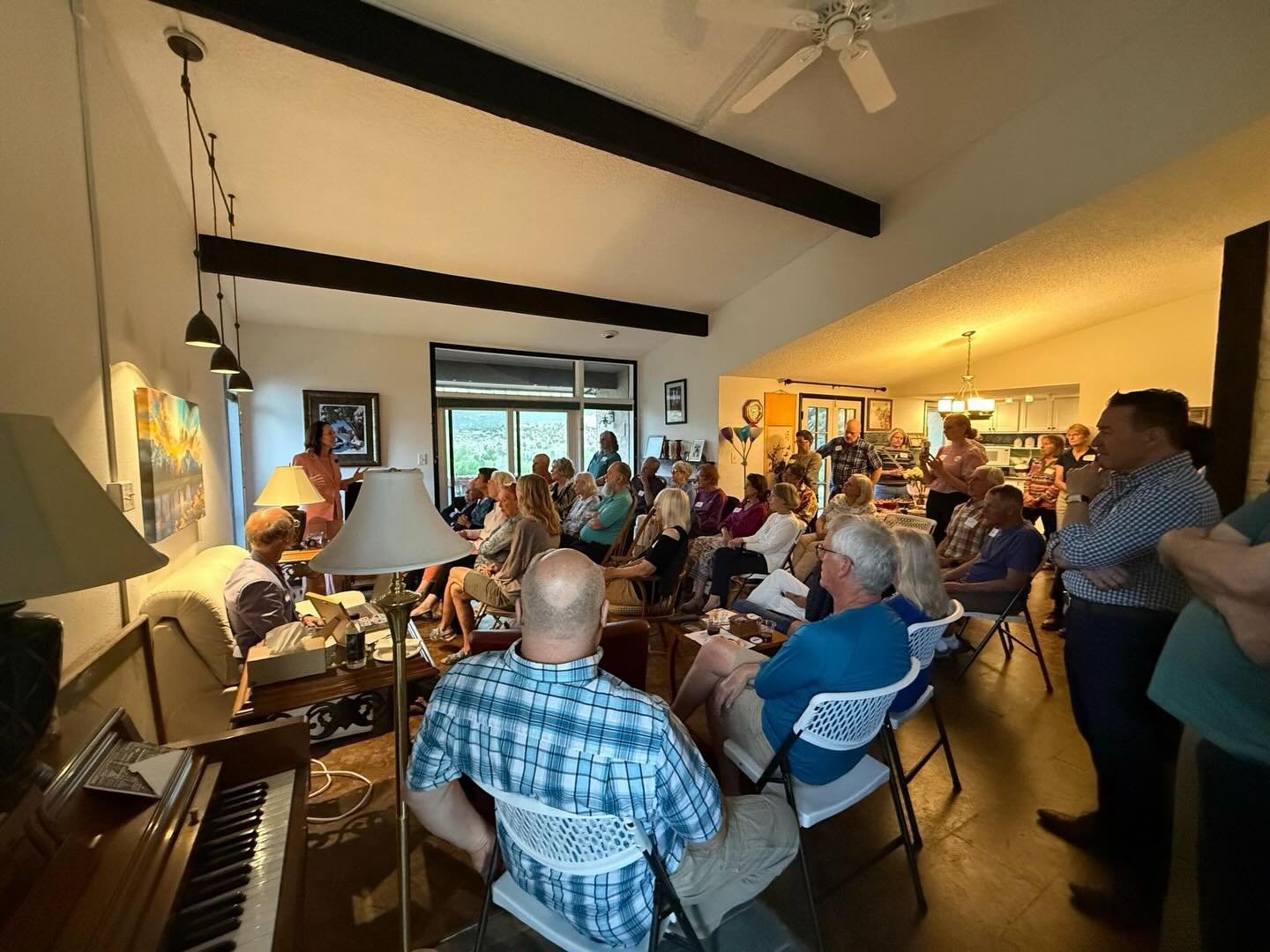
Jessica Killin (standing in the corner at the back left of the photo), Democratic congressional candidate in Colorado Springs, addresses a crowd of 50 at my home on May 15. I’m sitting on the white couch at left.
In my 11 years of service to global Christianity, I’ve interacted with believers in many countries who suffer due to government corruption, mistreatment of Christians, or authoritarian rule. Generally, the threats they face—especially those related to corruption—are subtle and concealed, because corrupt people don’t normally announce their corruption publicly.
By comparison, the US government has descended to a rarely seen level of open corruption. Last week, it announced the creation of a $1.776 billion “anti-weaponization” fund, intended to compensate people who were supposedly victimized by the previous government. People involved in the January 6, 2021, assault on the US Capitol could be eligible for payments.
The fund is part of a so-called “settlement” resulting from Donald Trump’s lawsuit against his own government. In the settlement, Trump’s government promises never to pursue any civil claims or tax audits against Trump.
A more vivid, public example of government corruption could hardly be imagined. As legal analyst Joyce Vance wrote in a Substack post, “The optics of this are so bad that it’s hard to believe Trump would expose himself to their consequences unless he really needed this deal.”
One senator of the president’s own party said after the US attorney general defended the slush fund, “So the nation’s top law enforcement official is asking for a slush fund to pay people who assault cops? Utterly stupid, morally wrong—take your pick.”
I suspect that being openly corrupt is part of Trump’s delusion of grandeur, because one way for him to solidify his power is to take obviously ridiculous, unethical actions and then watch nearly all the members of his own Republican party stay silent because they are afraid to anger him.
I was involved in many Republican political campaigns from 1990 to 2018. The last candidate I worked for lost his university teaching post three years later because of his Facebook posts from the US Capitol during the riot of January 6, 2021. My wife commented, “If he had just gone into the Capitol, broken a window, and gotten arrested, he could receive a million dollars now.”
I’ve been urging whoever would listen to me, and especially evangelical Christians (who are widely perceived as supporting this administration), to oppose Trump for a long time. I published an explicit call to principled (and, of course, nonviolent) resistance in April 2025.
With every crisis, though, comes an opportunity to serve and discover renewed hope.
The best way for Americans to restrain Trump right now is to elect as many members of the opposition party (the Democrats) as possible this year. Since I have both considerable political experience and free time to offer, I did not feel I could sit on the sidelines in good conscience, just as Dietrich Bonhoeffer felt he needed to return to Nazi Germany in 1939 rather than remaining safe in the United States.
Therefore, in February I offered my services to a Democratic candidate for Congress in my home district, Jessica Killin. The city of Colorado Springs has elected a Republican to Congress 27 consecutive times since 1972, but its demographics are changing and Killin has raised more campaign funds than the incumbent, Jeff Crank, who has been a dutiful Trump supporter for the last 16 months.
If all you read is right-wing media, you would think that the Democrats have a demonic, anti-Christian agenda. But actually, there are lots of Christians in the Democratic party. Since February, I’ve had the pleasure of receiving coaching from three Christians who have assisted Democratic presidential candidates.
On May 15, Nancy and I welcomed Killin at our home for the “house party” shown in the photo above. We crammed 50 people into our living area and recruited new supporters for the candidate.
My efforts as a RENF (Republican enjoying new friendships) have been appreciated in unexpected ways. At one recent event, while responding to a question about the political attitudes of conservative Christians, Killin said, “We have Bruce here, he’s an evangelical who could weigh in on that.”
I’m not looking for personal recognition, but if I can build greater respect and understanding between Democrats and evangelical Christians, that would be a plus for both groups.
Killin has to defeat one other Democratic candidate in a June primary election to earn the right to compete against Crank in the fall. However, she is already exhibiting the spirit that could make her a unique bridge builder in this moment of intense polarization. Last week, a young voter asked her how she would work with Republicans. Killin responded, “I am comfortable having difficult conversations. I plan to break bread with them. I’ll start by asking about their family and their personal experiences. I’ll find shared values with them and then build toward common policy goals.”
Killin’s answer sounded remarkably like how the Global Christian Forum (which brings evangelicals, mainline Protestants, Catholics, and Pentecostals to a common table) starts with personal storytelling to build friendship and trust. In that regard, Killin is a better example for Christians in public life than those who seek to mobilize foot soldiers for culture wars by demonizing the opposition.
When you experience conflict with others in your community, try listening to their story. You might find them surprisingly receptive to making friends and mending strife.