How to respond to Christian authoritarianism
An eye-opening interview with Matthew D. Taylor
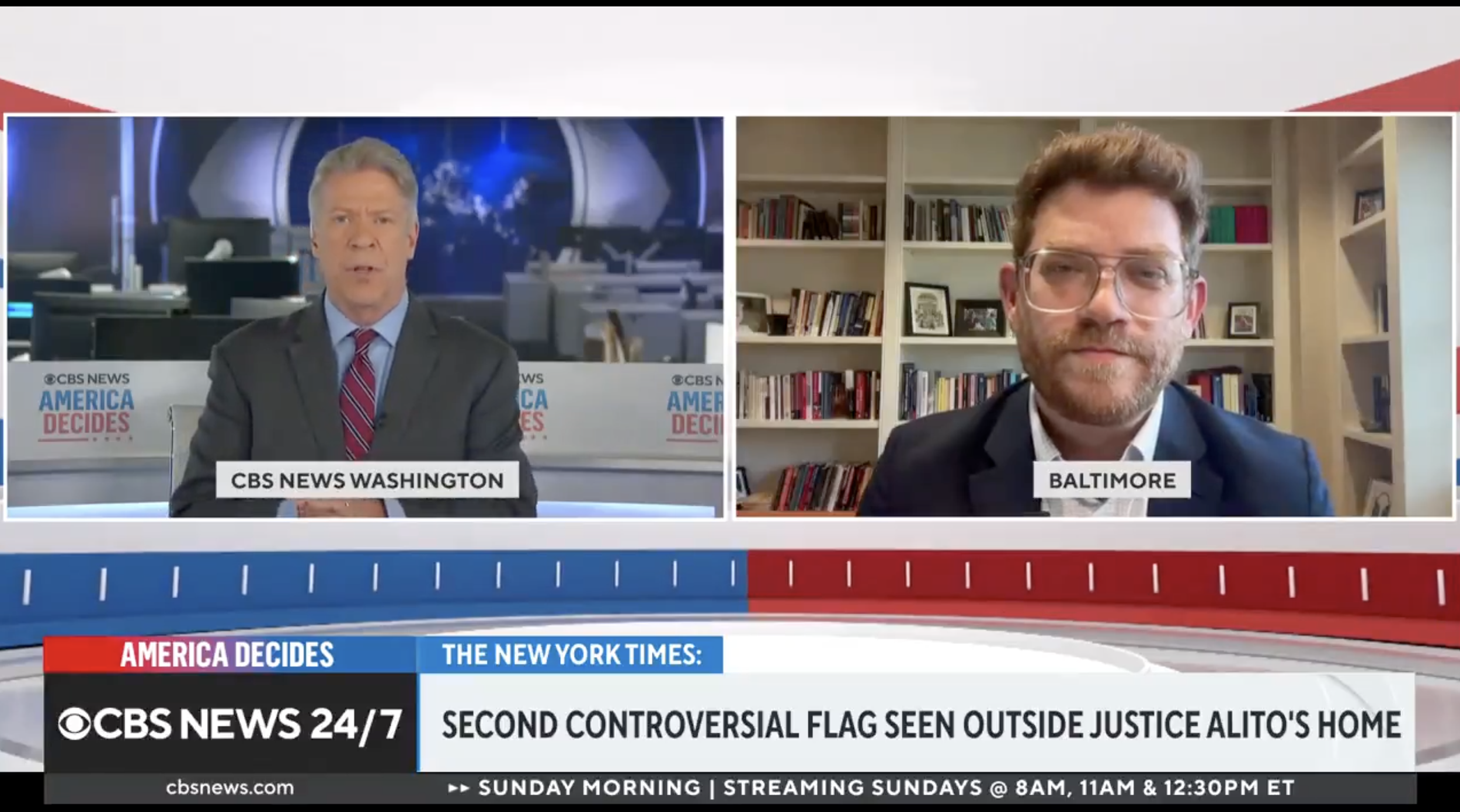
A screenshot of Christian scholar Matthew D. Taylor conducting an interview with CBS Television.
Does a group of independent charismatic figures, many of whom were discredited when they prophesied Donald Trump’s victory in the 2020 US presidential election, have significant influence on Trump and his current administration?
Matthew D. Taylor thinks so. A visiting scholar at Georgetown University’s Center on Faith and Justice, Taylor has done more than any person on earth to track one of the most unusual alliances between Christians and political power in history—specifically, the close alliance between the New Apostolic Reformation movement and Trump.
Taylor, whose work I highlighted last November, came to Colorado Springs on May 7 as a guest of the Center for the Study of Evangelicalism and kindly agreed to visit me for breakfast that morning. I read his book, The Violent Take It by Force, thoroughly before his visit. Even though I know the topic very well, having published the first serious study of “dominion theology” in 1992, Taylor’s work was still eye-opening.
Taylor is a first-rate scholar who learned his trade from the great American religious historian George Marsden, among others. He treats in amazingly sympathetic manner a movement that has done such things as traveling to the base of Mount Everest for three weeks of prayer because some of its members thought that a territorial spirit called the Queen of Heaven was impeding the progress of the kingdom of God (and, rather ambitiously, that their prayers would take care of the problem). Though he does not pass judgment on NAR spirituality in the book, Taylor does call this expedition “one of the strangest episodes of 1990s evangelical history.”
Even if you don’t live in the US and don’t care about US politics, the NAR worldview has infected independent charismatic practice in many parts of the world, so it’s important to be aware of this movement and its implications.
The following Q&A has been constructed from my conversation with Taylor.
How did you get into studying this group?
My first book, which grew out of my Ph.D. dissertation at Georgetown University, was about the American Salafist movement, a form of so-called “radical Islam.” Along the way, I drew many parallels to US evangelicals. I submitted the draft of that book to the publisher for review on the morning of January 6, 2021—the same day as the riot at the US Capitol.
I had a lot of moments of déjà vu watching the riot play out, seeing many of the evangelical signs and symbols I grew up with on display and being used to vindicate this attack on our democracy. I felt I needed to learn more. I started by reaching out to Ché Ahn, an NAR figure who is like me a graduate of Fuller Seminary. He spoke at a major rally in DC the day before the Capitol riot. Through him, I was able to interact with others in the movement, and I eventually did a whole podcast series (Charismatic Revival Fury) and a book-length project about the NAR’s central role in the events of that day.
Give an example of where you see actual NAR impact on policymaking.
The task force that developed Project Esther, which was presented as the Heritage Foundation’s [a prominent conservative think tank] strategy to combat antisemitism, was led by NAR people. That policy was implemented in the second Trump administration’s crackdown on colleges and universities and especially on Muslim international students who were critical of Israel’s war on Gaza. Ironically, many Jewish groups have opposed Project Esther, and the task force that created it ultimately broke with Heritage over fears that it was being taken over by people with antisemitic leanings themselves.
[See Taylor’s May 15 Substack post for additional examples.]
Why is there such intense interest in Israel within the NAR movement?
The NAR leaders are Christian Zionists (Christians who support the modern state of Israel for Christian theological reasons), but they aren’t like the old guard of dispensationalist Christian Zionists who are pining for the rapture. The NAR leaders want to see Israel victorious and dominant. In fact, the NAR movement overlaps to a significant degree with messianic Judaism. Their vision of Christian supremacy has a carve-out for Israel. These charismatics have built their worldview around spiritual warfare and around expecting a great breakthrough in their lifetimes. They are accelerationist in their politics, because they want to see things happen now. They are not thinking about developing social change over generations.
Isn’t the NAR only one of the various groups of Trump-supporting Christians?
Yes. Along with independent charismatics, there’s a significant movement of Calvinist-oriented Christian Reconstructionists like Doug Wilson and his acolyte, [Secretary of Defense] Pete Hegseth. Conservative Catholics are in the mix as well, and JD Vance is a kind of avatar for far-right reactionary Catholics in the administration. Then there are the legacy conservatives from the religious right as it has existed for 50 years, such as Franklin Graham and Mike Huckabee [Baptist pastor and Trump’s ambassador to Israel].
These groups differ somewhat in theology, eschatology, and political agendas, but they generally agree on an anti-“woke,” anti-immigration agenda and on Christianizing education. In the current context, they also all have to agree that the 2020 presidential election was stolen.
This collection of groups has become a hardened subculture, experiencing what I call epistemic closure. They are not open to other views. However, there are some fractures within the MAGA movement, such as over whether to inflict violence domestically on immigrants with no criminal record and whether to support a new age of American imperialism in alignment with Israel.
How would you characterize the political situation at this crucial time in the US?
You can divide the US populace roughly into thirds that exist in separate groups. There is MAGA on one side, built around right-wing media and pro-Trump propaganda. At the other end of the spectrum, there’s a “blue bubble” made up of people who are almost all college-educated, living in urban and suburban areas, consuming mainstream media, and identified with the Democratic party or a progressive coalition. I call them a bubble because they are surrounded by people who are like them. They tend to have a fairly narrow cultural consensus about what is good for America. For example, they exclude feminists who are pro-life on abortion from women’s marches.
The middle third is the hardest one to define. They get their information from various media sources. Many of them are in the economic underclass. The main disconnect between them and the blue bubble is level of education. Overall, I would say they are more open to listening to far-right propaganda than to mainstream media.
The occupants of the MAGA bubble are virtually unreachable and unpersuadable today, because they are caught up in the propaganda and groupthink of the far right. The task of saving American democracy, as I see it, is finding ways to unite the blue third and the middle third into a diverse, big-tent, pro-democracy coalition that can swamp Trump and MAGA’s authoritarian efforts to rig the 2026 and 2028 elections.
How do we reach our Christian friends and neighbors who are vulnerable to nationalist or authoritarian solutions?
Far-right religious nationalist movements around the world generally try to unite and galvanize a religious majority by telling them their cultural power is being threatened. Meanwhile, the center-left tends to default to secular abstractions like the rule of law and separation of powers.
If you’re an evangelical working three jobs to make ends meet, and someone says they have a message from God that Trump is our anointed deliverer, and someone else says “we have a tradition of the rule of law in this country,” which message will sound more attractive and important?
To defeat authoritarianism, we don’t need a unified approach where everyone sings the same tune. We need to enlist many different groups in the project of saving democracy. Pope Leo is good at this, but we also need Reformed people to articulate a democratic vision. We need Pentecostals and charismatics to use their theological voices to proclaim equality and justice.
To overcome the threat of an authoritarian takeover, you need to unite more than 51 percent of the people, because rigging elections is part of the authoritarian playbook. You need not just a “big tent” coalition but a giant tent. To people who are still focused on their own particular, controversial issues, I say that those issues are important in a democracy, but if you don’t preserve democracy, all the other debates won’t occur. You have to stop authoritarianism first.
What message would you like to share with the global part of this audience?
This Christian supremacist ideologies that I write about are not merely contained within the US. In fact, the environment that I study and in which these ideas of Christian power and dominance tend to flourish—the independent charismatics, who combine lack of denominational guardrails with charismatic spirituality—is the fastest-growing sector of global Christianity. The independent charismatic sector of Christianity was estimated at 312 million people in 2020 and has been basically doubling in size every 20 years.
We are dealing with the rise of transnational networks that prioritize Christian hegemony over society as the highest good. It’s not always aligned simply with racial or political issues, but it is fueled by prophecy and spiritual warfare rhetoric. Charismatic spirituality is very adaptable to different cultural contexts, and there are cynical politicians who have allied with them to advance their extreme visions for society.
So Christians globally should pay attention to what is happening in the US, because it is happening or could happen in other places as well.