Evangelicals love refugees and immigrants!
Their attitude puts them at odds with anti-immigrant policies
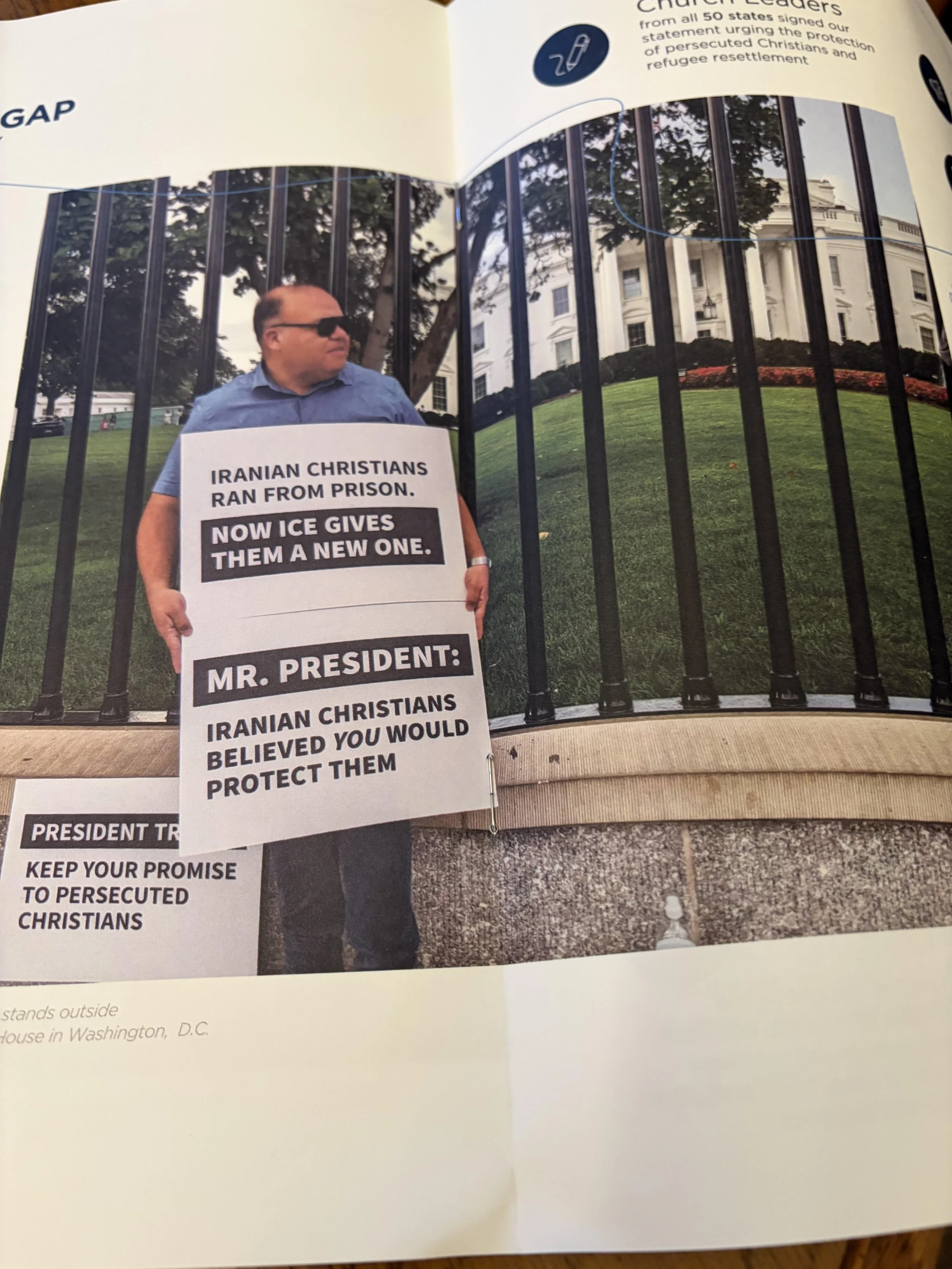
Ara Torosian, a pastor from Iran who was imprisoned for his faith before emigrating to the United States in 2010, protesting at the White House after immigration authorities unjustly detained fellow Iranians attending his Los Angeles church. The photo is taken from the centerfold of World Relief’s 2025 annual report. World Relief, affiliated with the National Association of Evangelicals, has been one of the leading US organizations in refugee resettlement.
Restrictive policies on immigration have gained support in Europe due to unwanted arrivals such as refugees fleeing the Middle East and migrants crossing the Mediterranean Sea, and in the United States because of large inflows of migrants from Latin America.
Christian attitudes toward immigration issues are mixed. For example, a 2025 study found that 90 percent of US evangelicals want tough border security, but 70 percent or more support taking steps to care for refugees and immigrants already in the country, including illegal immigrants with no criminal record.
World Relief, the relief and development arm of the National Association of Evangelicals, has been one of the leading US providers of refugee assistance. Since January 2025, World Relief has had to deal with the Trump administration’s cutoff of government funding for its work, as well as a challenging environment in which people living in the US legally have faced an unpredictable risk of being detained or deported.
Yesterday (May 4), World Relief and the NAE released a report projecting that at current rates, 1.3 million more children and spouses will be separated from family members during the remaining years of the Trump administration. Noting that many of these people are in the country legally and have no criminal record, the report stated, “The grief and trauma US citizen spouses and US citizen children are experiencing is unimaginable. Part of the church’s responsibility is to come alongside families inside and outside of their congregations.”
Matthew Soerens, World Relief’s vice president for policy and advocacy, kindly talked with me last week about the situation and what his organization feels God is calling them to do.
Q&A with Matthew Soerens
How are you navigating life under the current administration?
We’ve been trying to follow the same principles as we always do on policy issues. Our work is firmly rooted in biblical convictions. We believe God has special concern for the vulnerable. Caring for the poor, orphans, and widows is mentioned often in the Bible.
Simply understanding what the policies actually are has become harder. We’ll hear statements from the Department of Homeland Security that don’t align with what we’re experiencing on the ground.
We are concerned about issues of religious freedom and how they are affecting the church’s ability to minister to people. The administration’s loosening of restrictions on immigration enforcement in church settings has had a profound impact on church attendance, not only by immigrants but also by their family members, since no one wants to be responsible for Grandma getting deported.
Pastors and church leaders are wrestling with how to square Romans 13 [on obeying the civil authorities] with welcoming immigrants. I put people at ease by telling them there is nothing in the law that prevents them from baptizing and instructing immigrants, regardless of their status.
In response to the current situation, we have made more media statements. We keep our tone measured and always try to speak with respect. But we are direct in addressing policies that are inconsistent with our biblical convictions. That was true in the Biden administration too. We expressed our strong opposition when President Biden set a ceiling of allowing a maximum of 15,000 refugees per year into the country. That wasn’t what he had said during his campaign. To his credit, he reversed course. Now, we strongly oppose the Trump administration’s ceiling of 7,500 refugees.
We generally support legal immigration, but the refugee resettlement program should be for people who meet the legal definition of a refugee. At the moment, Afrikaners [white South Africans] are the only people coming in, while Christians persecuted for their faith, Sudanese fleeing war, and Afghans threatened by the Taliban are excluded.
It seems to me that many Christians are anxious to invest resources in reaching Muslims abroad with the gospel but reluctant to have Muslims as their neighbors. What is going on?
A lot of that comes from the framing of Muslims as people who are out to get us. That’s not true of the average Muslim living in North America. If I want them to know Jesus, the best way for that to happen is if Christians welcome and care about them.
There is still great support for our work among evangelicals. After President Trump canceled our funding for refugee services in January 2025, we promptly raised $12 million from donors.
Most evangelicals have nuanced views on this topic. We support border security and a careful vetting process for immigrants. But 90 percent of evangelicals also say we should protect the unity of families and not have small children taken from their parents. Of course, that’s necessary when the family is a violent criminal. But in other cases, evangelicals are not comfortable with separating family members. By ICE’s own statistics, 70 percent of the people they’ve gone after have been people with no criminal record.
In a survey conducted by Lifeway Research, 76 percent of evangelicals supported giving illegal immigrants a path to legal citizenship if they paid a fine and met other requirements. Ask them if they support amnesty for illegal immigrants and they say no. But they don’t associate paying a fine with amnesty. Evangelicals believe in the rule of law, but they believe there can be consequences for illegal immigrants, such as paying a fine, that are less serious than tearing families apart. That is our position too.
Are you finding that conservative evangelicals are reconsidering support for Trump due to his policies on refugees and immigrants?
Many evangelicals are not hearing what’s happening because of where they get their news. The emergence of smartphones and related technologies has changed media consumption. Everyone used to get their news from a relatively small number of sources; now an infinite number of algorithms are feeding people news. A lot of evangelicals today rely on media sources that don’t tell them what is actually happening.
When I was young, Charles Colson was very prophetic about how postmodernity would cause people to lose sight of a commitment to objective truth. However, I didn’t expect that problem to come from the evangelical community.
What pressures or criticisms have you received from your constituency or other Christians?
Some have dismissed us because we’ve taken government funding since the 1970s. They think that makes us compromised in some way. But the only way you can resettle refugees is to work with the government!
We believe that faith-based organizations should be able to compete on a level playing field with other organizations to deliver needed services. We do good work that serves a goal of the government, and we should not be excluded from doing so simply because our faith motivates our service.
It’s frustrating when false information spreads regarding us, such as that we are involved in trafficking or smuggling at the border. Happily, our supporters are not susceptible to conspiracy theories. We have an easier time than our denominational partners, because the self-selecting portion of a congregation who works with us knows that not all refugees are terrorists.
Some people think we should be speaking up more or opposing everything this administration does. But we are committed to focusing our limited capacity on those issues that directly impact the populations we serve.
How have you seen attitudes change over the last 15 months of the Trump administration?
I think there is a lot of frustration with what President Trump has done on immigration and foreign assistance. If he had just controlled the border, evangelicals would be thrilled. But he didn’t stop there. He went into the interior of the country and detained non-criminals. Some evangelicals don’t know that, because their preferred media sources don’t tell them. But many others do, and I believe this is the main reason for the decreasing support for President Trump among white evangelicals.
I expected him to take a tough stance on immigration, but I was shocked by his shutdown of the US Agency for International Development. It seemed to come out of nowhere. In the US, there is still limited realization of what the USAID shutdown has meant. Many Americans dramatically overestimate the amount of the federal budget that has gone to foreign assistance. When people understand the tiny share of the budget that goes to foreign aid and the number of lives saved, they see things differently.
Historically, the world has admired the United States. That is not true today. Rightly or wrongly, people think of us as a Christian country. To the extent that the Trump administration’s values are presumed to be Christian while we are negatively affecting the work of healthcare institutions globally, that is troubling for our witness.