For a secular culture, Christian business-as-usual won’t fly
We need bold creativity, tireless determination, and gracious respectfulness. Mark Rodgers is an example.
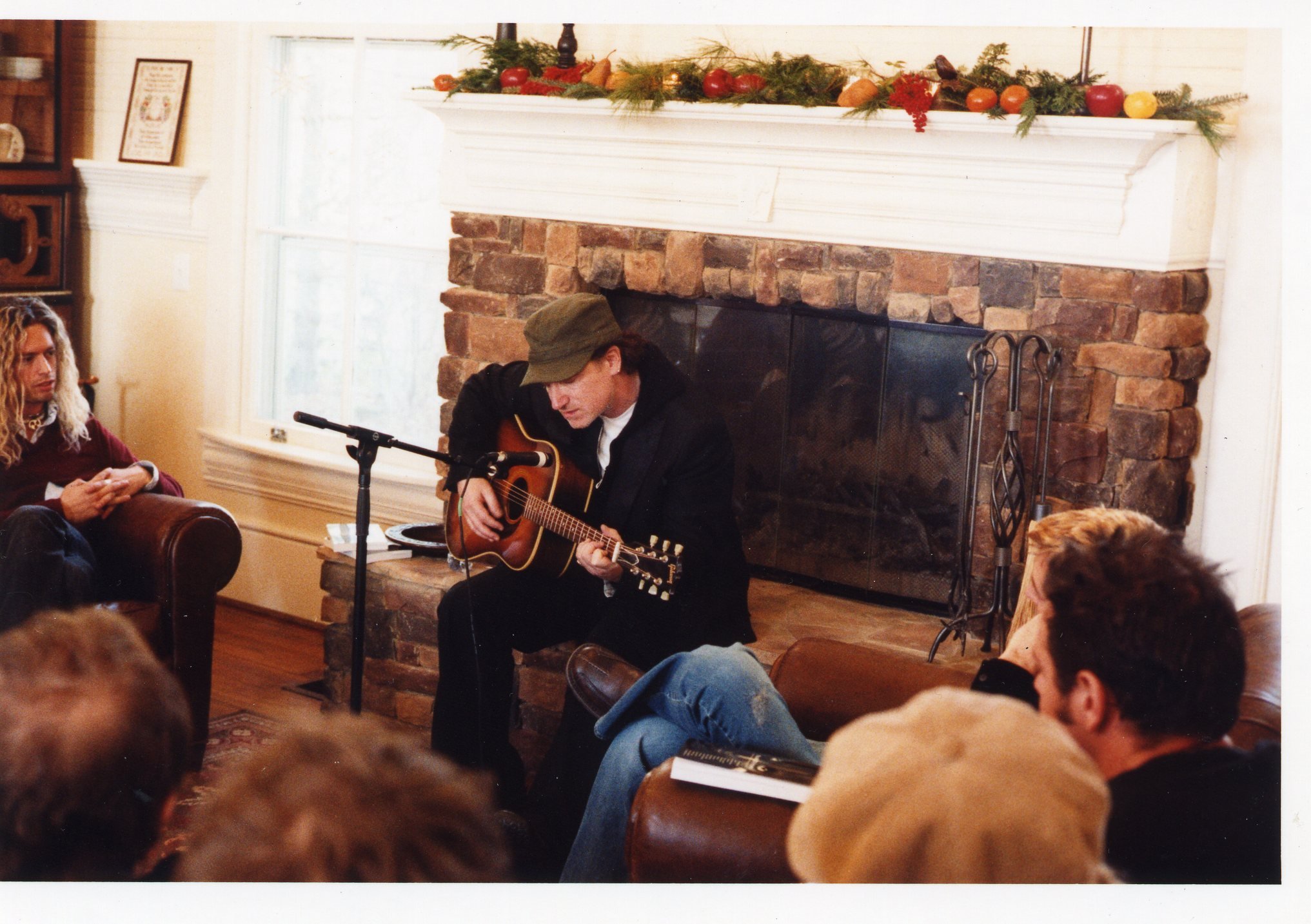
Here’s a secular musician who has made a spiritual difference. This is Bono, lead vocalist for the Irish rock band U2, performing for a group of Christians in the US while he was advocating for AIDS relief. His efforts help to gain approval of the President’s Emergency Program for AIDS Relief (PEPFAR).
Many Christians view popular culture as a lost cause. After all, how often do you see Christians among the award winners for the best movies or popular songs (unless they have a separate category for Christians, as the Grammy and Latin Grammy music awards do)?
Mark Rodgers sees things differently. He’s been teaming up with creative Christians to shape the culture for a long time. Who else would have brought Megadeth, the famed heavy metal band whose lead guitarist is a professing Christian, to the US Senate dining room?
Rodgers received deep Christian formation at home; his father was dean and president of the most evangelical Episcopal (now Anglican) seminary in the US. But he attributes his life inspiration to hearing a sermon in 1984 on William Wilberforce, the great British Christian politician responsible for ending UK participation in human slavery.
After 16 years as a high-level aide on Capitol Hill, Rodgers formed the Clapham Group (named after Wilberforce’s group of collaborators, the Clapham Sect) in 2007. Consistent with Wilberforce’s opposition to cruelty toward animals, one of his first clients was the Humane Society, whom he helped to build a faith-based outreach program for those who love both God and animals. More recently, his film The 21, on the Coptic Christians martyred by ISIS in 2015 after they refused to deny their Christian faith, was shortlisted (i.e., among the top 15 candidates) for an Oscar nomination in the “best animated short film” category in 2024.
If you’re looking for creative ways to change your culture, you should listen to Rodgers, who graciously granted me a recent interview. You can also visit or subscribe to his Substack, Salt and Light Stories.
You were a Capitol Hill aide for 16 years (1991–2006). Where did you find likeminded Christians to support your vision for ministry and influence there?
Most of the Christian-oriented policy advocacy groups define their agenda in a way that limits the breadth of what they can do. Issues like animal cruelty don’t fit into their portfolios.
On the other hand, most of the Christian ministries on the Hill focus on evangelism and personal discipleship. That’s important, but I needed to be challenged more.
The only organization I was attracted to was Faith and Law, founded in 1983. [Editor’s note: I featured Paul McNulty, one of Faith and Law’s two founders, in a blog post last March.] One of the first lectures I heard there was by Reformed theologian R. C. Sproul on the role of natural law. Writer and public theologian Os Guinness frequently spoke to the group.
Around 2001, the organization hosted well-known sociologist James Davison Hunter, who had just written a working paper that would eventually grow into his book To Change the World. We talked about how Christians could have what he calls a “faithful presence” in culturally influential sectors of society that shape people’s worldview: academia (his own sector), media, politics, entertainment. We also discussed the growing relevance of story as a way to communicate truth and meaning in an increasingly postmodern culture, in which truth was up for grabs and reason was seen as subjective. Video streaming was just beginning at that time. I perceived that storytelling would become a more dominant method of meaning making and worldview formation.
These experiences led me to think more deeply about how the arts shape culture. One of the first artists we reached out to was Bono, lead singer for the rock band U2. Bono was around Capitol Hill in 2000 supporting the Jubilee initiative, which was urging wealthy nations to forgive debts owed to them by poorer countries. That’s how he and I became friends, which led to us working together on AIDS issues.
[Rodgers and his boss, US Senator Rick Santorum, were key players in the enactment of the President’s Emergency Program for AIDS Relief (PEPFAR) in 2003.]
Beginning in 2001, without making any effort to politicize them, we met with numerous Christian musical artists. We talked with them about how culture is “upstream” from politics and discussed issues, such as the importance of marriage, that artists are uniquely positioned to address.
Many Christians in the arts focus on producing content either for the church (such as worship music or Christian fiction) or for evangelistic purposes. For them, this expansion of their vocational vision to serving the common good of society was both challenging and emboldening.
Bringing Christian artists onto Capitol Hill must have been interesting.
Some of my most favorite memories are of taking artists to the Senate dining room for breakfast. You have to wear a jacket and tie there. The artists often showed up without a jacket and tie, so I had to dress them properly.
The one artist I could not accommodate was Dave Mustaine of Megadeth. I thought he was coming alone, but he showed up with his whole band—all of them wearing black leather and chains. I couldn’t fix this one, so I explained the situation to the cafeteria staff, every one of whom wanted to meet Megadeth. Dave is a believer, and I think he has been thoughtful about how to use his public platform.
How did you pursue your interest in supporting Christian creativity after you left Capitol Hill?
In 2007, along with starting the Clapham Group, I founded Wedgwood Circle, which connects investors with artists, executives, and entrepreneurs who are creating entertainment that is good, true and beautiful for the common good. Later, wanting to be more directly involved in projects, I stepped back from leading Wedgwood and created More Productions, named for Hannah More, a playwright and poet who was part of Wilberforce’s Clapham Sect.
We funded one of Bono’s films. Probably the most prominent project we supported was director Martin Scorsese’s film Silence (2016), which tells the story of Catholic Christians under persecution in 17th-century Japan. The film was not commercially successful, but it was critically acclaimed. Variety magazine, in an article on Scorsese’s 26 films, ranked Silence as number one. It called the film “an incredible meditation on our relationship with God … and how our physical manifestation limits our comprehension of Him.”
Since the film was theologically complex—even for evangelical Christians—I recruited Japanese-American visual artist Makoto Fujimara to be an ambassador for it. I was his book agent for Silence and Beauty: Hidden Faith Born of Suffering, published by InterVarsity as a complement to the movie.
How have you carried Wilberforce’s inspiration forward into contemporary culture?
Wilberforce had two great objectives: the abolition of slavery and the reformation of manners. For him, the latter was a broad framework for recovering lost virtues. His colleague Hannah More wrote Manners of the Great, in which she said that reformation of manners must begin with the great (the aristocracy at that time, or the elites in our day) to be effectual. She recognizes that the elites are the wellspring from which the masses develop their character and habits. Today, the elites who play that role are artists and storytellers.
What suggestions and inspiration would you like to offer for Christians who resonate with your vision, especially those in the Majority World?
Many Christian artists who felt called to address the mainstream culture shared with us that it was very difficult to continue their vocational faithfulness. They often felt unsupported by the church theologically. I encourage church leaders to seek out prominent Christian artists and performers in their country and work with them to find ways in which their work can serve God, not just in direct evangelism but in shaping their culture.