On America’s mythical Christian past
Lessons from a case of writing history how we might wish it was
A false witness will not go unpunished, and he who pours out lies will perish. —Proverbs 19:9
Today, the United States celebrates its 250th birthday. Commemorative signs refer to “250 years of freedom,” which seems somewhat ironic since our free press, freedom of expression, and (especially for Hispanics) freedom of religion have been under threat for the last 18 months.
Some of the Americans who have supported these recent restrictions on freedom also believe that the United States is a “Christian nation” and that our laws and our public education should favor Christianity. To defend this claim, some of them have rewritten the nation’s history to make its founding sound more Christian than it really was.
The US founders—the people who wrote the Declaration of Independence in 1776 and the Constitution in 1787—were overwhelmingly religious, but not all in an explicitly Christian sense. As the second US president, John Adams, said in 1798, “Our constitution was made only for a moral and religious people.” But many of the founders, such as Benjamin Franklin and Thomas Jefferson, held views closer to deism—which acknowledged a Creator but did not acknowledge Jesus as divine—than to orthodox Christianity.
The founding documents reflect this breadth of religious views. The Declaration of Independence appeals to “the laws of nature and nature’s God,” a “Supreme Judge,” and “Divine Providence,” all terms that would be acceptable to both deists and orthodox Christians. The Constitution contains no explicitly Christian language, and it prohibits religious tests for eligibility to hold public office.
Despite this evidence, efforts to reshape US history in a Christian mold persist. Perhaps the best-known example was David Barton’s book The Jefferson Lies, which sought to depict Jefferson as an orthodox Christian. The book’s publisher, Thomas Nelson, ceased its distribution in 2012 after reputable historians challenged the accuracy of the book’s claims.
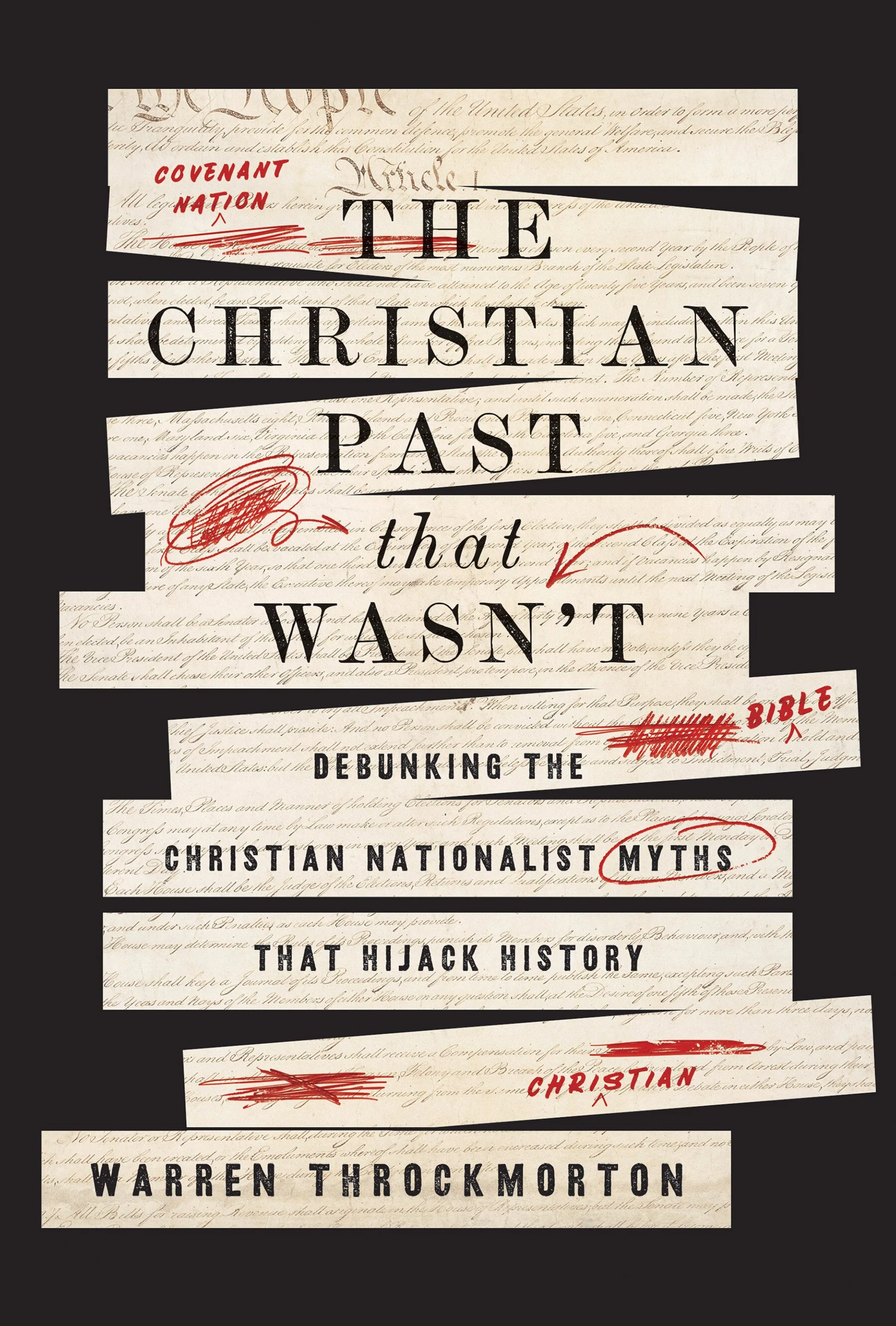
Warren Throckmorton, a retired professor who taught psychology at solidly Christian Grove City College, has been painstakingly studying these issues for more than 15 years. He chose to celebrate our nation’s 250th birthday by publishing The Christian Past That Wasn’t, a careful and thoroughly researched book that distinguishes truth from myth in Christian accounts of the US founding.
You can learn how Throckmorton got into this study and read extended excerpts from his work in historian Kristin Du Mez’s recent Substack post. Even better, buy the book yourself. I’ll limit myself to a few observations and applications here.
Throckmorton’s psychology background positions him to comment authoritatively on why people, especially Christians who are supposed to value truth, often accept untruth. Here’s part of his explanation:
First, people are attracted to Christian-America folklore because it helps meet psychological needs basic to human nature. These needs relate to existential fears and insecurities that promote nationalism and in-group loyalties.
Second, I assert that contemporary Americans believe some or all of these of these myths because their Christian and political leaders tell them they are true. Some of these myths have been passed down for generations, and they have become mixed up in American identity. I demonstrate that many influential Christian leaders spread historical myths because the stories are politically beneficial propaganda.
Throckmorton also draws on his psychology knowledge to show that these behaviors reflect “confirmation bias,” or our tendency to accept and remember information that is consistent with our existing beliefs, and a preference for conformity with the views of our cultural group.
That pressure for conformity can have disturbing results. Throckmorton describes instances of Christian organizations that continued using Barton’s material, despite awareness of its weaknesses, because it was helpful to their interests or because they did not want to offend his followers.
Throckmorton addresses this problem sensitively, in a manner I can appreciate because I too have faced sharp criticism at times for pushing back against the prevailing theological or political views of my evangelical subculture:
I am aware that the pressure to conform to the prevailing view of political engagement in America is great for white evangelicals. It is difficult to go against the grain. I understand how it works. Leaders of organizations catering to white evangelicals are dependent on the support of donors; if they don’t produce a winning message, donations dry up. It takes real courage and a willingness to sacrifice one’s career to challenge the status quo within one’s social group. Some have been willing to do that over the years, but that has not been the norm. So fracturing a little history might seem like a small price to pay.
The same kind of pressure exists among everyday citizens who might question the prevailing Christian America narrative. It is hard to be the one who says the founders didn’t pray at the convention if your pastor on Sunday morning says they did. The people you go to church with might question your faith and wonder whether you have “gone woke.” The skeptical looks and ostracism are hard to take when you contradict Christian nationalist myths.
As Throckmorton demonstrates, Christian efforts to impose their will in the public square are rarely beneficial. Those who seek to require religious instruction in public schools, for example, have forgotten the lessons of the Crusades and the Inquisition—namely, that faith cannot be compelled and that attempts to do so provoke resentment toward the faith being forcibly inculcated. Baptists, due to their historical position as a persecuted minority, have traditionally prized church-state separation as a means of ensuring religious freedom, but for many of them, their angst over the appearance of receding Christian cultural influence seems to have overridden that historical principle. The viewpoints Throckmorton seeks to debunk have had significant negative consequences, as they motivate Christians to support government impulses that do not respect the equal rights of all people.
I believe that Christians should indeed celebrate the US founding documents, but for different reasons. They are special because Christians worked collegially with fellow statesmen to build a system of government that has—albeit with major blemishes such as horrible treatment of minority groups—generally advanced the causes of religious freedom and human rights in unmistakable ways. Ironically, those freedoms are at risk today because, as Adams understood, the US constitution can be misused or trespassed should people come to power who are driven by greed and self-interest and who are neither moral nor religious.
A lesson for my global readers: do not revise historical or other facts because you think that doing so will serve your spiritual or ideological goals. Your abandonment of integrity will come back to haunt you. God can handle the truth.
I asked Throckmorton to share some positive impacts of his efforts and those of other responsible Christian historians over the last 20 years. He said:
Over the last several years, a growing group of people have strengthened their advocacy for democracy and for a proper separation between church and state. None of the principles I have expressed are original with me, but the fervent response to my book indicates that something is resonating with many. I hope my book will be one resource among many that will turn Americans back toward understanding the value of church-state separation mutual respect for religious differences.