Does Indonesia honor God better than Western societies?
An inspiration for “civil religious pluralism” comes from an unexpected place
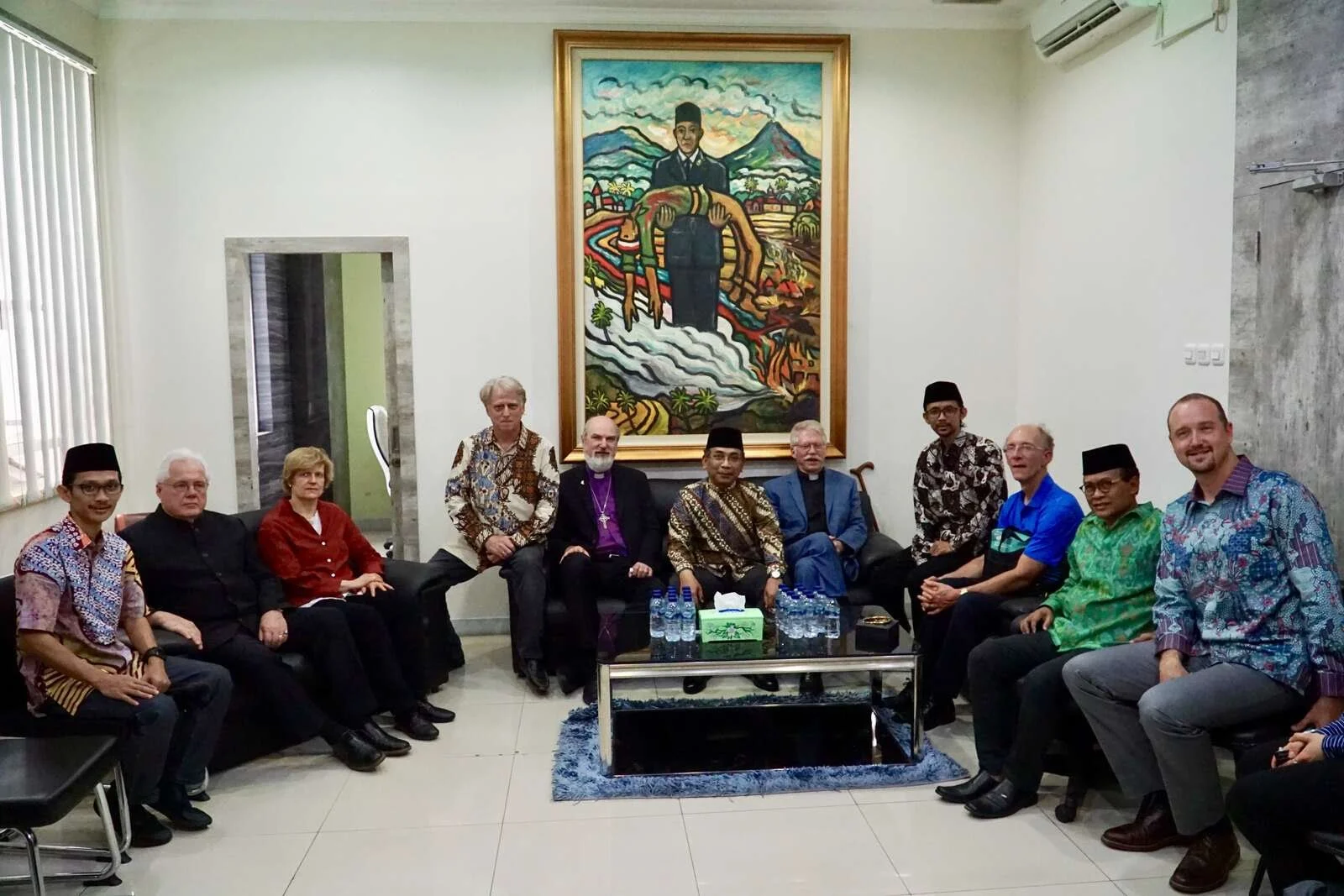
Kyle Wisdom (far right), now director of global advocacy for the World Evangelical Alliance, at a meeting with members of Indonesia-based Nahdlatul Ulama, the world’s largest Muslim organization, in 2019. (I am also in the photo, at right in the solid blue shirt.)
What place should God have in a healthy society? In a nation with many different religious groups, plus people who do not belong to any faith, should God be mentioned at all?
Many answers to that question have been proposed, from strict secularism in France to official acknowledgment of God in Zambia and Islamic countries.
I don’t believe that Christians should strive for a society that favors Christians over other citizens. But on the other hand, I believe that a society that banishes God completely from its system of public education, as the United States has essentially done, should not be surprised when some of its teenagers kill each other over petty disagreements. I believe that the proper answer to Glenn Tinder’s question in his classic 1989 article “Can We Be Good without God?” is “No,” on a societal level.
I was surprised to discover, as I became significantly involved in global work, that one nation whose answer to Tinder’s question seems closest to my own is not a country of Christian origin, but the one with the world’s largest Muslim population. Indonesia, as it became an independent nation in 1945, adopted five principles known as Pancasila. One of those principles is belief in one God.
Although I do not endorse Indonesia’s requirement that all citizens must identify with one of the six officially recognized religions, and although I’d say Indonesia had to do some creative mental gymnastics to classify Buddhists and Hindus as believers in “one God,” I appreciate the attempt to situate acknowledgment of our duty to a Creator as a key foundation of a good society.
Kyle Wisdom, the World Evangelical Alliance’s director of global advocacy, lived in Indonesia for 11 years. Earlier this year, Wisdom published Civil Religious Pluralism as Political Philosophy, in which he draws mainly from Indonesian Muslim philosopher Nurcholish Madjid to argue for a social philosophy that incorporates religion better than the classical liberalism of the Enlightenment West has done. Kyle is indeed full of wisdom (pun intended), so I invited him to share some of it here.
Q&A with Kyle Wisdom
When you were living in Indonesia, how did you see Pancasila’s commitment to belief in the “one and only God” affect daily life and the functioning of Indonesian society?
Some sort of understanding of the divine permeates all of Indonesian society. The 2025 World Religion Database estimates that 78 percent of Indonesians are Muslims, followed by Christians at 13 percent. It says that atheists make up just 0.1 percent of the population.
In most of the country, the Muslim call to prayer is heard in the background five times a day, most restaurants and food vendors are quick to point out their halal menus, and it is common to see religious dress among men and women.
Indonesia requires citizens to indicate affiliation with one of the officially recognized religious groups. How do you feel about this requirement? What is its practical impact?
It’s a very interesting requirement for a modern nation and a clear rejection of secularism. The constitutional court recently ruled that the religion category need not be explicit on every government ID card, though there was some backlash against this decision. This was a positive step for minority religions not recognized by the government.
I am sympathetic to the desire for ensuring that citizens acknowledge God, though I’m uncomfortable with the external pressure to identify with a religion one might not actually believe in. This linkage can also make it difficult to ensure the fundamental aspects of religious freedom as detailed in article 18 of the United Nations’ Universal Declaration of Human Rights and the International Covenant on Civic and Political Rights. Having one’s religion on their ID card makes it difficult to officially change one’s religion without incurring societal backlash, especially if one is converting away from the majority religion.
How does Indonesia ensure respect for various traditions?
Indonesia’s decentralization of much of its decision making under president Joko Widodo (2014–2024, better known as Jokowi) led to a wider variety of implementation and prominence of Pancasila. The respect for various traditions varies widely by province and the different demographics in them. The provinces of Papua, North Sumatra, North Sulawesi, and parts of Kalimantan have large and vibrant Christian populations, where the social settings are much friendlier to pluralism despite the country-wide Muslim majority. In many other provinces, while the legal support for Pancasila is similar, social hostilities are much greater. Civil society organizations promote different streams of Islam, and some of them are militant. These are occasionally regulated by the state, but there is an ebb and flow in enforcement and government engagement. In the wake of Islamic State activity, the government was quite forceful in rejecting this ideology and dealing with more radical groups.
Under Jokowi, some other notable regulatory actions took place, such as the cancellation of the legal registration of the Islamic Defenders Front, which had been quite active in stirring up riots around Ahok’s public comments and trial. [Ahok was an ethnic Chinese Christian who became governor of Jakarta, Indonesia’s capital city, but was convicted and imprisoned for blasphemy after militant Muslims protested a statement he made about the Qur’an.]
The good work of Nahdlatul Ulama, a 100-year-old Indonesian-based organization and the largest Muslim entity in the world with 40 million members, is a bright spot in the civil-society space as they promote their traditional view of Islam and also support religious freedom.
In your book, you advocate for a positive role of civic religion, pointing to Indonesia (via Nurcholish Madjid) as a more favorable example than Western secularism. Why is that? How would you like to see Western secularism adjusted?
I argue for civil religious pluralism, which describes the obligations of the state to ensure a just society by including religious moral orders in a dialogue about what is right and good. I think Western secularism has given itself a privileged position by assuming its own neutrality while treating all other religious traditions as biased and unreliable. Everyone has a bias, and it’s better for all parties, including the state, to accept that and come together as equal partners to discuss what is right and wrong and what we want our societies to look like.
In my view, the state has a burden to foster this conversation. The state has the power of enforcement through its legal code and defines some of what is allowable in society, but it does not have the resources to promote morality, connectedness, social cohesion, and a vision of the good on its own. It needs religion to support a well-functioning society, and therefore it should foster a dialogue that includes religious traditions rather than ignoring them.
This does not mean that we should aim for a theocracy or overly align religious power with the state. Trying to do that has gotten the church into a lot of trouble over the centuries. But neither should we separate religion from the state so far that they are isolated from each other. Civil religious pluralism, as I have articulated it, is an attempt to chart a middle path between liberalism and theocracy that could undergird a healthy society.
What are the main lessons from your research and practical experience that you would like Christians to know?
Christians need to be politically engaged, but we should not be pushing to establish a “Christian nation” in today’s diverse societies. When we are in the majority, we should support and work for religious freedom for others, just as we seek religious freedom for our persecuted Christian brothers and sisters in difficult places around the world. This form of political pluralism enables members of different religious traditions to live together in peace and without violence. It is not the same as theological pluralism, where we give up our convictions or belief in our own faith tradition as uniquely revealed truth. We can and should affirm political pluralism even while not affirming theological pluralism. We can and should make space for Muslims to worship in Christian-majority countries because we want Christians to have space to worship in Syria, Iran, or Indonesia.