The withering of Christianity in eastern Turkey
Theology professor James Edwards witnesses the state of Christians in a largely forgotten region
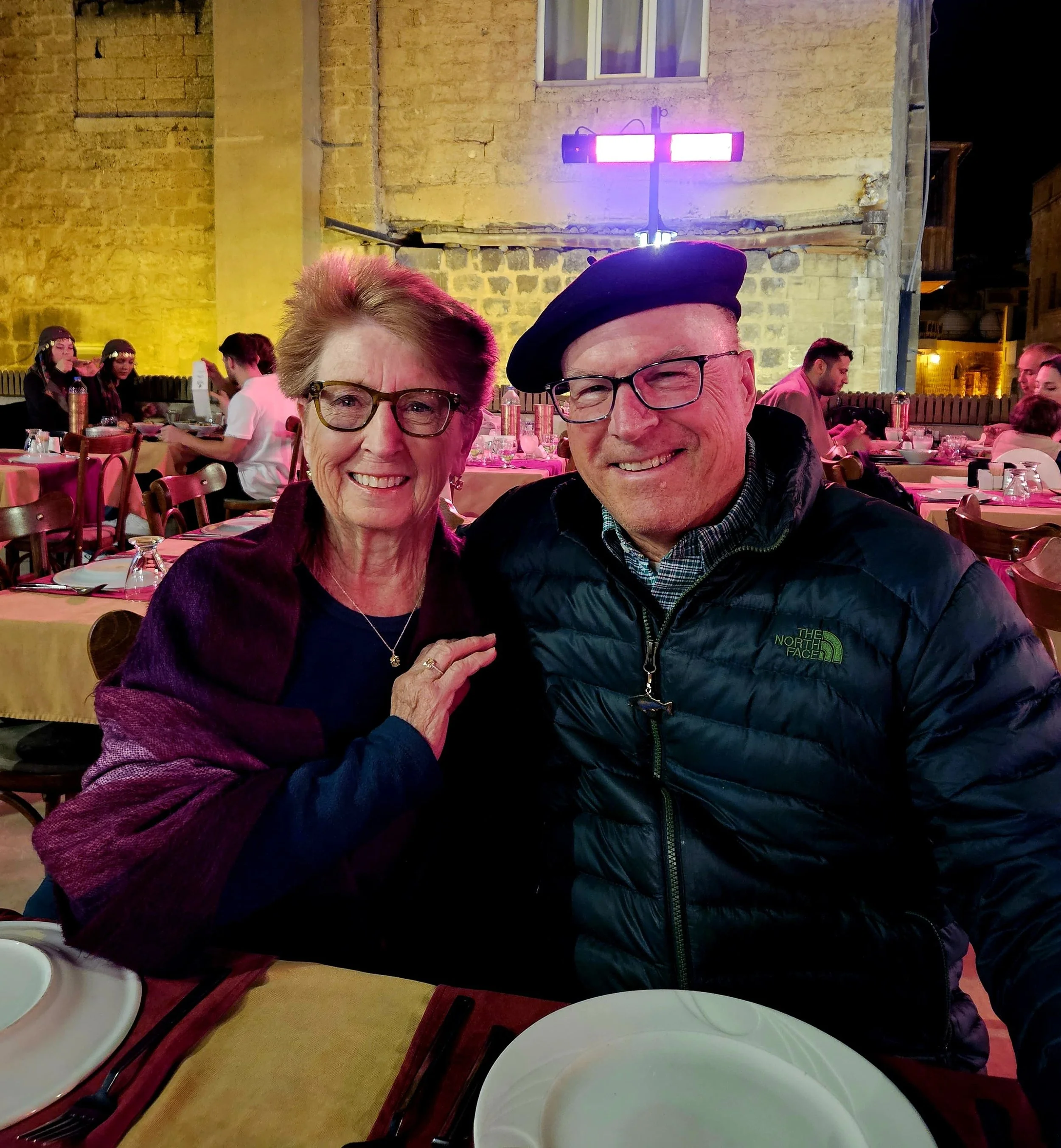
James Edwards and his wife, Janie, at an outdoor event in Turkey.
I hear frequent laments about the tribulations of Christians in Palestine, Syria, or Iran. But I never hear about another nearby region where a once-flourishing Christian culture has been virtually obliterated: the eastern third of Turkey (or, if you accept Turkish president Recep Tayyip Erdogan’s preferred spelling, Turkiye).
The region has a rich Christian history. Most Christians visiting the country focus on locations of significance in the New Testament, such as Ephesus, Cappadocia, and the seven churches of Revelation 2–3. All these sites are in western Turkey. But other important cities lie farther east, such as Antioch (now Antakya), the city from which Paul and Barnabas departed on mission in Acts 13.
The book of Acts records the westward missionary expansion of the gospel from Antioch. But the gospel also expanded eastward from Antioch to regions beyond the Roman empire that spoke primarily Aramaic or Syriac rather than Greek or Latin speaking as in the west. Like the Orthodox and Catholic churches to the west, the eastern churches were also Nicene in confession, but in several important respects the eastern face of the Christian community differs from the western face.
A major distinction of the Syriac church in the east is its expressed division of the two natures of Christ (divine and human). In contrast to the Council of Chalcedon in 451, which affirmed that Christ’s two natures were “without division,” the east emphasized the duality of Christ’s natures, often resulting in a Nestorian confession.
The church in what is now eastern Turkey coexisted with Islam for centuries. The area was predominantly Christian until the Armenian genocide conducted by the Ottoman Empire beginning in 1915.
Earlier this year, James Edwards, the Bruner-Welch Professor Emeritus of Theology at Whitworth University in Spokane, Washington, USA, toured biblical sites in eastern Turkey. In 2019, Edwards published a book entitled From Christ to Christianity (Baker Academic), in which he charted the spread of the gospel eastward as well as its better-known expansion westward. His journey to the headwaters of eastern Christianity in Mesopotamia was memorable and instructive. He shared his experiences with me in a recent interview.
Q&A with James Edwards
What’s different between the two halves of Turkey, from a Christian perspective?
Culturally speaking, the western part of Turkey is much more European that the eastern part. As a result of the influence of the Syriac Orthodox Church, the historic language of eastern Turkey has been Syriac. Syriac Christianity has tended toward Nestorian theology in contrast to Western Christian traditions of Orthodoxy, Catholicism, and Protestantism.
How do you view the significance of the Nestorian character of this church? Do you consider them orthodox (with a small “o”) Christians?
I do consider them orthodox Christians. We must understand that the Nestorian leaning of the Eastern church has been influenced by its historic interaction with Islam. The areas of Christianity that are Nestorian are predominantly Muslim. Christian missions found that Nestorianism, with its emphasis on the humanity of Jesus, was more theologically attractive to Muslims because Muslims honor Jesus as a prophet but not as the Son of God. The Chalcedonian Christological definition [of Christ’s two natures as indivisible], on the other hand, can swallow Jesus’ humanity in his divinity, which is offensive to Muslims.
To use a baseball analogy, a Nestorian Christian witness will get you to second base in ministry with Muslims, whereas a Chalcedonian witness leaves you in the batter’s box. Nestorianism allowed the church to begin the conversation with Muslims based on Jesus’s human nature rather than his divine nature.
Describe the condition of the church in eastern Turkey as you observed it.
We went to a large city in eastern Turkey that prior to the genocide of a century ago (which Syrian Christians refer to as the Sayfo) was 60 percent Christian. That same percentage was typical of the Christian population throughout eastern Turkey before the Armenian genocide. Today, perhaps 0.01 percent of the population is Christian. Many of the Christians in eastern Turkey were not Armenians, but they too suffered grievously in the pogroms in eastern Turkey a century ago.
The Syriac Orthodox church that I visited in that large city had only eight members. These precipitously low numbers of surviving Christians—usually in single digits—characterize current membership in historic Syriac churches that I visited. Syriac believers are present and active in many Western cities, including the New York City and Chicago areas, but in eastern Turkey they are on the verge of extinction.
Their reserve—even distrust—of the West is palpable. I am an academic with an interest in literary remains in monasteries. In the monasteries I visited, I requested permission to see their archives and libraries. Each monastery refused my request. My familiarity with Syriac literature and scholars was of no avail in gaining permission. The reason given for refusing my request was always the same: “Because you steal our books.”
Unfortunately, there is some truth in this. Western scholars have removed and failed to return books from St. Catherine’s Monastery in the Sinai and from the Ecumenical Patriarchate (the Phanar) in Istanbul. Evidently, some scholars have acted similarly at Syriac monasteries in eastern Turkey. The misdeeds of our forebears have been visited on us, their children, in this matter, for the libraries of Syrian monasteries are closed to Western scholars today. There is a tragic irony in this, from my perspective, for the estrangement of Eastern Christianity from the West—for whatever reasons—is a deprivation not only of the worldwide body of Christ but also of Syriac believers themselves.
There is, nevertheless, a witness to the gospel in eastern Turkey apart from the Syriac monasteries. In one city, I visited a Christian church with an attractive auditorium and coffee shop that had been rehabilitated from an abandoned building. Three young Turks received us warmly, and they freely recounted the story behind their vigorous evangelical Christian community of some 50 to 60 believers. As native Turks, they can do what Westerners cannot do.
What can outsiders do to make a difference in Turkey?
I cannot see many open doors to Westerners to aid the Syriac church. Under President Erdogan, the Turkish government has become more aggressive against Western involvement in Christian missions. A friend of mine who ministered faithfully for decades in Turkey—and who seemingly was assured of the right to do so—was recently deported. Others have suffered similar fates. Native Turkish Christian pastors seem less vulnerable to such governmental opposition. Our prayers for them, and for the Christians to whom they minister, are especially important.