On assignment in Beirut
A prominent Christian journalist describes life amidst bombings
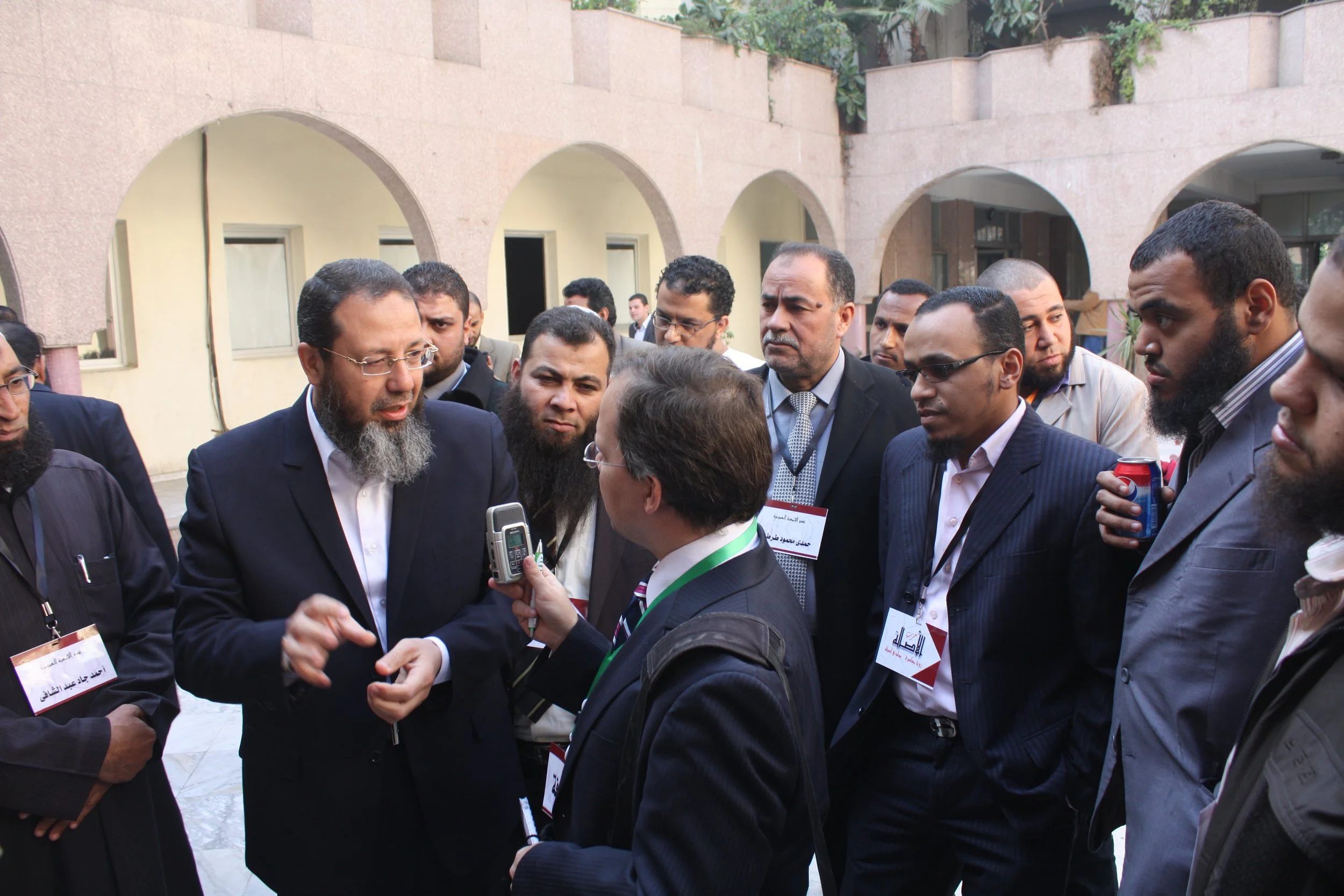
Christian journalist Jayson Casper interviewing a group of Muslim political leaders in Cairo, Egypt.
One of the best and least pretentious journalists I know is Jayson Casper, who has covered the Middle East for Christianity Today since 2012. Casper has authored numerous articles on Lebanon, Egypt, Israel-Palestine, and elsewhere, including this revealing 2024 coverage of the development of an evangelical alliance in Iran. He has also launched a “Middle East Harmony” Substack, enabling him to offerreflectiveinsights, commentary, and reporting that match the quality of his dispassionate journalism.
Q&A with Jayson Casper
What has life in Beirut been like since the Iran war began?
Lebanon is a strange, small country. We live 15 minutes away from the main concentration of Shiites in Beirut, where Israel bombed consistently prior to the ceasefire. When I say this to friends and family in the United States, they recall the horrific images of explosions and destroyed buildings in the media, immediately thinking of their neighboring shopping center.
So it is hard to comprehend when I tell them my wife goes shopping as normal and my children walk to school every day. They take hikes in the beautiful Lebanese mountains.
We live in a Christian neighborhood. In Lebanon, many communities largely self-segregate by religion. While Christians and Muslims maintain friendly relations and mix in common areas, most return home to areas marked by either statues of the Virgin Mary or posters of young Shiite men killed in the war.
As a million Lebanese have been displaced from their homes, many Shiites have found refuge in Christian areas, including our own. But this welcome has also raised tensions, both between the different groups and due to fears that Israel will track the location of Hezbollah members and bomb them here. Municipalities are checking IDs of non-residents, but some have gone unnoticed until destruction followed. You just don’t know.
The other day, a woman with a headscarf entered our apartment building. We have Shiite neighbors, but as I didn’t recognize her, I asked if she was visiting them or perhaps one of their displaced relatives.
Immediately she was apologetic. “See this hijab,” she said, “it is for God only. I’m not political, I’m not extremist, I’m not with Hezbollah. We are more upset about what’s happening than you are.”
I didn’t need to hear her plea; I’m sympathetic and tried to say so. But she felt compelled to justify herself. That is not a good sign for society. But it is where we are.
What calling is keeping you there, and what impact can you and your family have?
I’ve never preferred the word “calling.” God can communicate specific direction to people if he chooses, but in general we pray, ask him to guide us, discern with trusted colleagues, and then make the best decisions we can.
In one sense, we stay because this is home. We’ve been here for seven years. Our kids are in school, my wife has her friends, and we all appreciate our community. Leaving without knowing when we could come back would be far more disruptive than the current lived experience of war. It could get worse, of course, and we make no promises. But we love Lebanon.
I derive an incredible sense of meaning from working here at a critical time. I don’t wish to speculate about our impact. Most journalism doesn’t change the world. But we share information and perspectives that many people don’t have access to. And we can encourage our local friends. We offer little more than our presence, but they seem to appreciate it. We are very thankful for our life here.
You could easily become a Middle East correspondent for a secular media outlet. What keeps you committed to distinctly Christian journalism?
I appreciate your confidence in me. But there are so many good journalists out there.
I’ve always believed that is it better, in the abstract, for a Christian to succeed in regular media. Why just preach to the choir? But I have a strong desire for the West to know the church in the Middle East more deeply. Our region is often characterized as full of explosive religious tension, and I don’t want my spiritual community in the West to misunderstand a place I respect. It is far too easy for believers to yield to the viewpoint expressed by secular media sources as they analyze events from an American or Western perspective.
There is one other crucial element related to the importance of faith-based journalism. As Middle East Christians navigate their challenges with biblical convictions, they provide a model for Christians everywhere. Sometimes they flounder just as we do. Yet as Christians in the West enter an era of minority status that can sometimes be dismissive of their religion, they enter into a status that Arab Christians have dealt with for a long time. In their mistakes and successes, they can be our teachers.
What should Christians globally know about the Middle East situation that they tend to overlook? Or what would you like to see them doing?
There are two dominant stereotypes about faith in the Middle East. One is that Islam and Christianity are basically the same. This view is less prominent within the evangelical community. More frequent is the assumption that Muslims persecute Christians. Stereotypes exist because there is much evidence to back them up. But neither assumption respects the diversity of the region that only good reporting can bring out. Without it, stereotypes can easily be manipulated by agendas.
Similar nuance can help us better understand so many issues. Consider the Israel-Palestine conflict, for example. Christians can have many legitimate opinions on the relationship between security and justice. But far too few consider the perspective of the Palestinian church or of Messianic Jewish believers—communities who disagree strongly yet belong to the same body of Christ. It is their conflict far more than ours, and if we base our opinions primarily on secular analysis or favored interpretations of the Bible, we fail to honor the unity God asks us to pursue.
What if anything can you say about the truth behind the rumors of explosive growth of the Christian faith in Iran, or about how the Christians in Iran are faring in wartime?
I spoke recently with five Iranian Christian leaders in the diaspora. All said it was difficult to estimate the number of Christians in Iran, beyond the historical Armenian and Assyrian communities.
One gave me an estimate of five million converts from Islam, based on Bible distribution and viewership numbers of Christian satellite TV. Another estimated 500,000, based on expert testimony from the United Nations, or up to 800,000, based on the reporting of Open Doors and secular researchers. Christian growth is undeniable, evident in the reactions we have seen from the Iranian regime. But how much growth is widely disputed.
The perspective of Iranian Christians on the war is even harder to judge. The internet blackout makes it nearly impossible to get direct information, and my sources spoke of having had limited interaction with Christians in Iran since the war began. One source told me the Christians they knew were waiting for Trump and Israel to finish the job so they could rise up and take power. Another said their contacts were divided, some still hopeful the regime might fall while one cursed Trump for the collateral destruction. A third related testimony that economic conditions have become unbearable.
Most Iranian Christian converts would welcome the fall of the regime. But as they endure the present situation, there is uncertainty regarding the means employed, the chance of success, and the consequences that might follow if the government stays in power.
You can subscribe to Jayson Casper’s Substack here. Ronald MacMillan of the Five4Faith Substack has recently published comments from anonymous Christians inside Iran on their view of the war.