On not idolizing the Olympics
Lindsey Vonn’s experience and my family’s provide an illustrative contrast

Skier Lindsey Vonn competed in five Olympics from 2002 to 2026, winning a gold medal in 2010, but also battled depression and loneliness along the way.
Everyone who competes in the games goes into strict training. They do it to get a crown that will not last, but we do it to get a crown that will last forever. —1 Corinthians 9:25
The 2026 Winter Olympics began this past weekend. One of the biggest stories so far was not a victory but a crash. Lindsey Vonn, one of the most decorated skiers in history, appearing in her fifth Olympics, attempted to compete despite having suffered a torn ligament just a week earlier. She completed a training run successfully, but in her first competition, she fell and broke her leg within 13 seconds.
I won’t criticize Vonn for trying. Despite having been retired for more than five years before returning to the sport in November 2024, and at age 41, she was at the top of her game again, winning a World Cup downhill race in December.
Vonn’s determined attempt reflects how important the Olympics were to her.
Such an intense, lifelong pursuit of athletic greatness can carry both physical and emotional costs. Vonn endured not only multiple serious injuries but depression and loneliness. “Success does not equal happiness,” she commented in a podcast interview while retired. “There were a lot of times when I wasn’t happy.”
The contrast between Vonn’s life and my own family’s unlikely Olympic experience is striking and instructive.
In 2001, our daughter earned an all-expenses-paid-by-Dad trip to a national youth track and field meet. Her 8-year-old brother Trevor, jealous about being left home, vowed to do anything he could to make nationals the next year. Trevor tried every event available to his age group and discovered that he was good at the most obscure one of all: race walking.
(Yes, there really is race walking in the Olympics.)
Trevor trained more diligently than any young race walker in US history (except for a six-month period when, tired of people laughing at him during his workouts, he switched to running). In 2009, he placed fourth at the world youth championships. In 2012, at age 19, he recorded the fastest 20-kilometer race walk in US national championship history and finished mid-pack (26th of 56 starters) at the London Olympics.
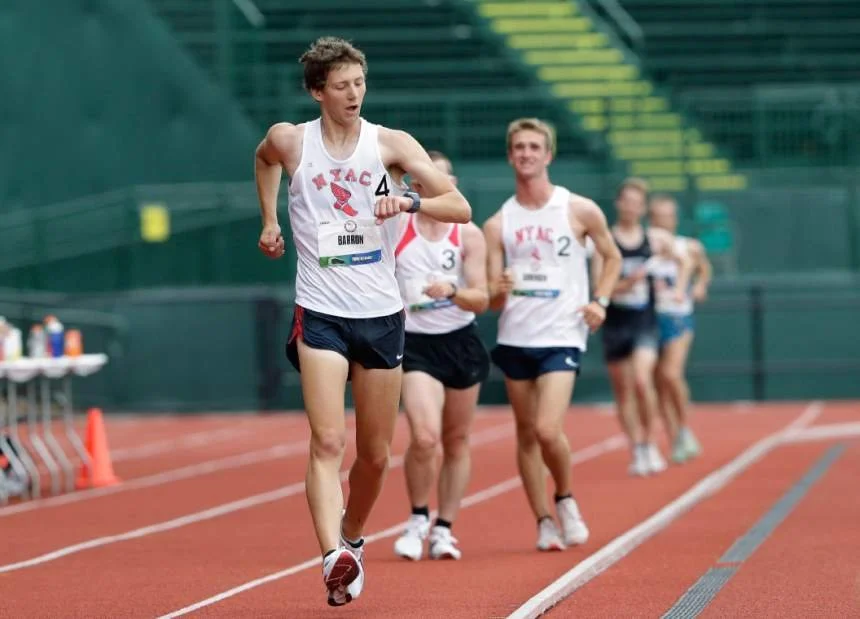
Trevor Barron checks his watch while completing one of his 50 laps in the 20-kilometer race walk at the US Olympic track and field trials in 2012. Source: Pittsburgh Tribune-Review.
Then, with a bright athletic career in front of him, Trevor retired.
It wasn’t a hard decision. Trevor loved making friends all over the world, but he did not want to continue conforming to the restrictive demands of world-class athletic training. He had a different bright career in mind: he has been a robotics engineer at Apple since 2019.
As Trevor told one interviewer, “I’m not going to give up my life for the Olympics. Some people do.”
We had trained Trevor to idolize only God, not the Olympics or anything else, and he definitely took us seriously!
Trevor competed to the best of his ability, but he was not deceived by the allure of recognition or money (partly because US race walkers get no recognition and virtually no money). When he addressed the 2010 USA Track and Field annual meeting as youth athlete of the year, he joked about race walkers’ obscurity and then recalled a quotation from Jesse Owens, the black Christian who won four gold medals with Adolf Hitler watching at the 1936 Berlin Olympics. Owens said, “Awards become tarnished and diplomas fade. … What is a gold medal? It is a trinket, a bauble. What counts my friends, are the realities of life: the fact of competition and yes, the great and good friends you make.”
For a Christian, athletic success is not the ultimate goal, but it is a platform. It gives athletes opportunities to express their faith in a credible manner.
In 2018, I had the privilege of writing about Christian members of the famous Pittsburgh Steelers US football team. In 1974, on the way to their first Super Bowl championship, the Steelers experienced a significant spiritual revival. About half the team made meaningful Christian commitments. They became positive influences on their teammates and on thousands of others who admired their exploits.
Tony Dungy, the first black coach to win a Super Bowl, was among those impacted. He attributes his spiritual awakening to conversations with his roommate at a Steelers training camp when he was a player.
I hope you will admire great athletes without idolizing them, and that you will encourage young people to participate in sports without overemphasizing the value of winning. Sports opens up great ministry opportunities and is a great place to learn life lessons, which is perhaps why we can find four sports metaphors in the New Testament (1 Corinthians 9:24–27; 2 Timothy 2:5 and 4:7; Hebrews 12:1).