Our slow cultural slide into being not nice
As basic friendliness declines, we have a chance to be different
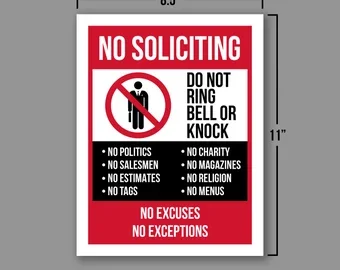
An example of the signs Americans are increasingly using to avoid conversations with strangers.
Make it your ambition to lead a quiet life … so that your daily life may win the respect of outsiders. —1 Thessalonians 4:11–12
Sometimes, simple observations speak volumes about where our culture is going.
As a volunteer for a political campaign, I spend a few hours a week going to nearby neighborhoods to tell people about my candidate. If no one answers, I leave a handout describing the candidate. If someone answers, I explain why I am at their door and invite the resident into a brief conversation about the upcoming election.
I have done this type of grassroots work many times, but not since 2018. As I do it this year, I’ve noticed how our culture is changing.
The most obvious change over the last 30 years is the weakening of community-wide friendliness. In the 1990s, people had strong political feelings, but hostile reactions were very rare. Now, many people don’t want to talk at all.
About one of every 10 doors has a “no soliciting” sign. Some signs are more explicit, adding “no politics, no religion.” I prefer the lighthearted ones that add, “We know who we are voting for. We have found Jesus.”
Electronic doorbells and cameras provide another layer of distancing. Some people answer by speaking through the doorbell system, without coming to the door. In other cases, the doorbell tells me to leave a message.
I’ve been screamed at five times in approximately 1,000 doors. One angry man chased me down his driveway.
Other campaign volunteers prefer to make phone calls to voters, but I find today’s version of phone canvassing unattractive. In 2012, when I spent three months managing a phone bank for a presidential campaign, most people still answered the phone. Today, their smartphones show them the incoming caller’s number in advance, sometimes with the enticing descriptor of “potential spam.”
Moreover, when someone does answer, the phone system needs about one second to notify the volunteer (who is not actually dialing numbers but just looking at a computer screen) of the connection. Whenever I answer my own phone and get one second of silence, I conclude that this is a call I really don’t want and hang up quickly. So do many other people. Therefore, achieving a friendly conversation over the phone is much more difficult.
Candidates like to introduce themselves to local civic and social groups such as the Rotary Club or Kiwanis Club, but participation in those groups has declined also, and many of them avoid getting involved in politics.
One other more personal option is home-based events where the host invites friends to come to a party and hear the candidate. We held a successful event of this type in May. But we had to invite nearly 250 people to get 50 to attend.
With person-to-person communication methods losing their effectiveness, political candidates are increasingly relying on paid advertising and mailings. As a result, campaigns are less personal and more dependent on professionally constructed messages that offer big promises and spread negative information about the opposing candidate.
The social changes I’m describing follow the pattern that Robert Putnam described in his influential 2000 work Bowling Alone. Putnam observed that although more Americans were participating in the sport of bowling than 20 years earlier, participation in bowling leagues had decreased. He saw this pattern, along with the reduced number of participants in civic organizations, as reflecting a decline in social engagement that could negatively affect democracy.
Amidst this social trend, I have an evangelistic suggestion for Christians: be nice to strangers, because people will notice you are different. Smile at people. Offer help to someone carrying a heavy bag. Ask your neighbors how they are doing.
When I need a refreshing break from political and social conflict, I go to the Manitou Incline, the famous stairway (formerly an incline railway) near my home that rises nearly 2,000 feet in elevation over 2,768 steps. During summer, the Incline attracts about 1,000 users a day, mostly tourists. Everyone is in good spirits despite the scenic but physically challenging climb awaiting them. I offer to take photos, tell them where the steepest section is, and answer their questions.
It’s a joy to initiate conversation at a place with zero risk of an unfriendly response. When visitors express appreciation, I tell them that I try to be God’s gift to someone each time I come to the Incline. One climber who had just moved to our city later came to church with us.
I would love to receive some Majority World reactions to these observations. My general sense is that the Majority World experiences a stronger sense of community, except where civil strife has engendered deep-seated conflict and distrust.
If you have ideas or questions, you are welcome to call me. But be forewarned: my phone requires callers to identify themselves before I decide whether to answer!