Even in a trade war, material things are not the most important
The deeper meaning in Canadian Mark Carney’s bold stance
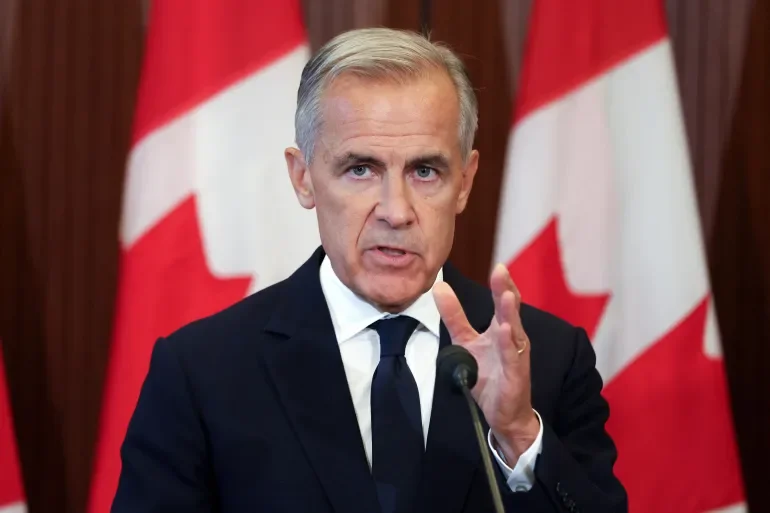
Canadian prime minister Mark Carney delivering an address to his nation on August 22, after the collapse of US-Canada trade talks. Source: Al Jazeera.
See that no one is … godless like Esau, who for a single meal sold his inheritance rights as the oldest son. —Hebrews 12:16
We read about wars and rumors of wars every day. Russia and Ukraine, Israel and Gaza, the US and Iran, Cambodia and Thailand, the DRC and Rwanda, and many more.
But the US and Canada??
According to Canadian prime minister Mark Carney, absolutely.
“You’re at war when you’re attacked, and we got attacked,” said Carney at a press conference on August 22. He had just delivered a resolute, somber but pugnacious 23-minute message to his nation after trade negotiations between Canada and the US collapsed.
This is a trade war, not a bombing war as in Ukraine or Gaza. People are losing their jobs, not their limbs or lives. But for Canadians, it’s an imminent challenge to their national existence.
Predictably, each side blamed the other. I can’t tell you exactly what was said in the last hours before Carney instructed his negotiators to walk away and return home, because I wasn’t in the room where it happened.
But I can tell you that Mark Carney was governor of the Bank of Canada and then the Bank of England and is one of the most widely respected world leaders today. In contrast, the US government is viewed as erratic, capricious, full of threats against its allies, and following the whims of a Nero-like leader. Besides that, the US government has repeatedly expressed a desire to undermine Canada’s sovereignty, quite similar to Vladimir Putin’s vision for Ukraine. So which side of the story do you think most of the world is believing?
(Sometimes, behaving in a way that earns trust has its benefits.)
Carney, who alternated between Canada’s two official languages when delivering his remarks, also indicated that the US trade negotiators’ position had a cultural component. “We were not prepared to compromise on the protection of the French language and our culture,” he stated.
I don’t know why US trade negotiators would care what language is spoken in Quebec (Canada’s main French-speaking province) any more than in Burundi or Laos. But that demand might be consistent with the Trump administration’s vigorous domestic and global crusade against various forms of diversity.
Standing up to a bully is popular. A survey by the Angus Reid Institute found that 76 percent of Canadians supported Carney’s decision. However, will that support continue if Canada experiences economic suffering? In the same survey, 13 percent of Canadian workers said they were very concerned about losing their job.
Canadian novelist Stephen Marche hopes his nation’s resistance will continue. In a New York Times essay, Marche wrote, “For Canada, the choice came down to either severe but temporary economic instability or binding itself to a pseudodemocratic fiscal basket case of a nation, whose only apparent foreign policy objective has become domination for the gratification of its president’s slapdash vanity.”
As a longtime fan of colorful sound bites, I liked that sentence. But I was more touched by a passage later in Marche’s essay. While acknowledging, as Carney did, that Canada may have to “tough it out” through economic pain, Marche expressed appreciation that “a gray banker, and not just any banker, but one of the leading bankers in the world, has stood up and said that there’s more to life than a little bit of money.”
That’s a theme Christians should resonate with.
The Israelites experienced considerable hardship under Pharaoh in Egypt. But when life in the wilderness became hard, they plotted to overthrow Moses and return to Egypt (Numbers 14:4).
In his parable about the rich fool, Jesus warned that “a man’s life does not consist in the abundance of his possessions” (Luke 12:15).
If Ukraine had rolled out the red carpet for Putin in 2022, Ukrainians would probably be safe from bombings and would have consistent electric service. But their culture would be destroyed, their children would be speaking Russian in school, and their sons would be subject to conscription should Putin decide to invade Estonia or Finland.
Canada has a lot at risk. Europeans, who have often resorted to flattery and appeasement in its dealings with the Trump administration, enjoy proximity to dozens of interlinked, friendly trading partners; Canada borders just one country. Finding trade replacements for that country when it becomes hostile is far more complex and costly.
Because the US economy is larger and more diversified, retaliatory actions by Canada could cause more economic suffering to Canadians than to Americans. But if Canadians feel they are in an all-out war, they may support cutting off energy and mineral exports to the US, as Doug Ford, premier of Ontario (Canada’s most populous province), has proposed.
Canadians are not ready to give up their soul for a mess of porridge. Unfortunately, most of them seem to have only secular motivations for their honorable stance. Perhaps Canadian Christians can point out to their neighbors (or neighbours, or voisins) that the things that give their lives deep, lasting meaning come from God.