Political homelessness can be a good thing
Three evangelical experts warn about the idolatry that can accompany partisanship
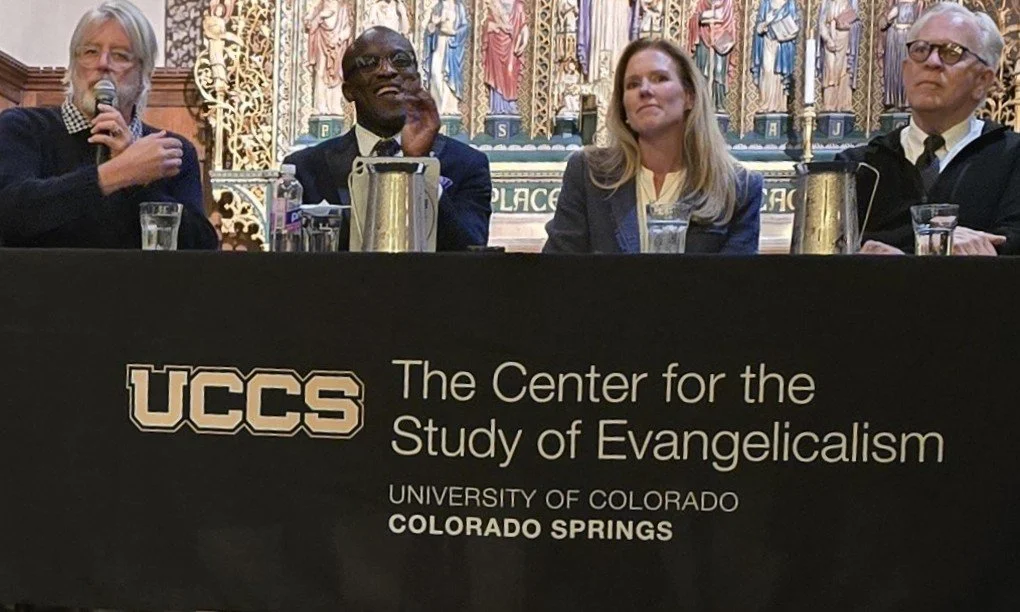
Speakers at the conference on “political homelessness” held in Colorado Springs on September 23. From left: Center for the Study of Evangelicalism director Jeff Scholes; Colorado Springs mayor Yemi Mobolade; Elizabeth Neumann, who was senior advisor and deputy chief of staff at the Trump administration’s Department of Homeland Security from 2017 to 2020; and retired Fuller Seminary president Mark Labberton.
“All these people … admitted that they were aliens and strangers on earth. People who say such things show that they are looking for a country of their own. If they had been thinking of the country they had left, they would have had opportunity to return. Instead, they were longing for a better country—a heavenly one. Therefore God is not ashamed to be called their God, for he has prepared a city for them.” —Hebrews 11:13–16
All Christians know that their primary allegiance is to Jesus Christ. But they don’t always act that way.
In the US, it often seems that many Christians’ primary allegiance is to their local football team. (The same thing happens in Latin America; it’s just a different kind of football.)
For the most part, cheering for the home team is a good-natured practice, as shown by the friendly welcome fans of the visiting team usually receive. But support for one’s own tribe, racial group, socioeconomic group, or political party can often become ugly, in a manner that Christians should never approve, let alone engage in.
Amidst the ugliness and polarization that pervade US politics today, our local university hosted an unusual event this week, featuring three prominent evangelical Christians on the topic of “political homelessness,” or what to do when there are only two parties and we really don’t feel closely aligned with either of them.
“If neither party reflects your spiritual values or sense of the common good, you are in a position of political homelessness,” said philosophy professor and event moderator Jeff Scholes. “And when the other side is consistently being called evil, just listening to each other becomes more difficult.”
I was expecting much of the discourse to cover Trumpian authoritarianism and Democratic wokeness—especially the former, since one of the speakers had worked for Trump and then publicly opposed him for reelection in 2020. But the participants did something better. They all reflected on Christian faith as a call to love God and neighbor and to avoid any idolatry that seeks to get in the way of that calling, including the idolatry of political parties.
Mark Labberton, retired president of Fuller Seminary in California, was the main speaker. To put the problem of political homelessness in its proper context, Labberton first reminded his audience of the millions of people who experience literal homelessness due to war, refugee status, and poverty. He then described a recent conversation with a pastor from Kyiv, Ukraine who makes frequent humanitarian trips to the front lines of war.
The disputed territories in eastern Ukraine have many residents of Russian descent, some of whom are believed to serve as informants aiding Russian military authorities. Nevertheless, this Ukrainian pastor said his team provides food and medicine to both Russians and Ukrainians. “For me, that is an example of the presence of the Kingdom,” Labberton stated. “God calls followers of Jesus into an enemy-loving life.”
Labberton bemoaned that so many Christians seem to be finding their identity in partisan political affiliation. “Why would you take the identity of being a child of God and sell it out for the sake of a political identity?” he asked. He speculated that fear (of cultural change or of people unlike us, for example) is a pervasive cause.
Labberton concluded, “Right now, the culture despises the church; we have left ourselves vulnerable to be criticized. People are looking for tangible evidence that our lives are countercultural, defined by love and mercy. Partisan politics was never meant to be our home.”
Elizabeth Neumann, who worked in the Department of Homeland Security during the first Trump administration, explained that at a women’s Bible study in 2011, after 10 years in government, she read Jeremiah 17:5–6, which begins, “Cursed is the one who trusts in man,” and felt convicted. “I had put a lot of trust in man,” she recalled—specifically, that government and business could solve our problems. “Competent government is a good thing, but it can’t carry the weight of my trust. God began to untangle my faith and my politics.”
When Neumann distanced herself from the Republican party, she said, “The hardest part was rejection by friends. But when it becomes a relational rupture, you realize that politics was more of your identity than it should be.” Neumann added that in her travels since publishing her book Kingdom of Rage, she has met many Christians who, even if they still associate with a political party, “are sensing that something about the way we are doing politics is deforming it. They see Christians excusing bad behavior because the person is on their side, or treating contempt as courage.”
Identifying both anger and withdrawal as unacceptable responses, Neumann instead encouraged her listeners to “see everyone as the image of God, even if [you think] their politics is appalling”; to evaluate politicians for their character and competence, not just whether they align with our agenda; and to engage with our neighbors in less glamorous but life-impacting ways at local levels.
Yemi Mobolade, the third speaker, is an inspiring example of local impact. In 2023, taking advantage of the fact that local elections in Colorado are nonpartisan, he ran for mayor without affiliating with either party and won a stunning victory.
Born in Nigeria, Mobolade came to the US at age 17. “I grew up Yoruba and experienced the beauty of tribe,” he said. “But I also saw the temptation to believe that because these are my people, others are less worthy—that loyalty to the tribe meant more than truth. That same temptation exists in American politics. The problem is not belonging to a tribe, but when belonging becomes greater than truth, justice, and recognizing the humanity of the other.”
Mobolade acknowledged that being unaffiliated with a party brings its challenges. If you are connected to a party, “When things get difficult, there is usually a group of people who say ‘don’t worry, we have your back.’ I don’t have that, and it can be lonely. I can make a decision on Monday that frustrates conservatives, and one on Tuesday that frustrates progressives, and sometimes frustrate both groups with the same decision.”
But Mobolade added that he never has to worry about what his own party’s position is when making a decision; he can just seek to do what seems right. “This is where my faith becomes inseparable from my politics,” he continued. “Being a pastor helped to prepare me for this job more than anything else. Pastors serve people who disagree with them.
“My political independence means I’m free to tell the truth, follow the evidence, and work with those with whom I disagree.”
I wish the speakers could have addressed how to maintain the spirit of political homelessness (exemplified by Hebrews 11:13–16, quoted above) even while participating in a political party. As I often reminded people when I was an active Republican, “God is spelled G-O-D, not G-O-P” (Grand Old Party, a common nickname for Republicans). But affiliating with no political party gives up a potential means of influence.
As my regular readers know, my response to the Trump administration and its threats to US democracy and the world order has been to help the other party. I’ve made new friends and am having a memorable experience, about which I hope to write soon—although to avoid giving away campaign secrets, I might have to wait until after Election Day on November 3.